The 2025-26 college sports season wrapped up with a string of surprises. The College World Series capped things off, following a standout year for the UCLA Bruins and MLB Draft #1 pick Roch Cholowsky. March Madness brought its own drama, with Michigan knocking off UConn. And earlier in 2026, the College Football Playoff National Championship gave us one of the biggest storylines of the year.
Indiana and Miami came out of nowhere to become national title contenders. Few people saw that coming. Indiana’s quarterback Fernando Mendoza had a season for the ages. He won the Heisman Trophy, led his team to the National Championship, and was selected #1 by the Raiders in the NFL Draft. Nobody predicted any of it.
These dramatic shifts reflect broader changes in all of college sports, not just football. The transfer portal and NIL (Name, Image, Likeness) deals have accelerated roster turnover and reshaped the competitive landscape.
Programs that adapt quickly and invest in recruiting, player retention, and player development now hold the advantage.
This volatility has created new opportunities in the college sports card market. Emerging stars and unexpected breakout performances can dramatically shift collector interest and demand.
The Basics
Licensed college sports cards are experiencing a dynamic resurgence. They unite a storied past with the momentum of today’s expanding collectibles market. Once centered on regional pride, regional sets, and alumni interest, collegiate cards now serve as the legitimate first chapters in the careers of tomorrow’s hobby stars. Another unique element of today’s college sports collecting is that products do not always focus on one sport. Multiple sports are often featured in a single product.
Today’s industry leaders Topps (Fanatics), Panini America, Upper Deck and ONIT continue to shape this space. They produce officially licensed releases that highlight college programs and capitalize on opportunities presented by athlete NIL (Name, Image, Likeness) partnerships.
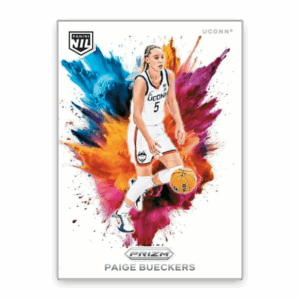
Modern college issues have the full look and feel of professional cards. They feature premium designs, high-end card stock, on-card autographs, game-used memorabilia, and creative campus-themed inserts. These releases have elevated the category from niche nostalgic keepsakes to essential pieces of the broader sports card market.
College Licensing 101
College licensing works differently than professional sports. Card manufacturers must secure agreements with individual schools, conferences, or entities like the NCAA, March Madness, or the College Football Playoff.
Topps currently has licenses with over 150 schools, including exclusive agreements with Alabama, Clemson, Florida State, Georgia, Kansas, Kentucky, LSU, Miami, Oregon, Penn State, Tennessee, Texas A&M, and Wisconsin.
Panini currently maintains non-exclusive agreements with several schools. It is unclear which schools specifically.
Upper Deck has agreements with 18 Division I schools, some of which are exclusive.
ONIT, a relatively new player to the college card game, started producing college cards in 2023. They began with the release of full sets for college programs. It is believed the company has made cards for more than 8,000 athletes across 212 men’s and women’s teams at 67 Division I schools.
All four of these card manufacturers must also enter into agreements with the college athletes. These agreements can be negotiated with athletes individually or through group NIL licensing. NIL has had a tremendous impact on the landscape of college sports and trading cards. For more details visit our Collectibles U chapter on Emerging Markets & NIL.
A Brief History of College Sports Cards
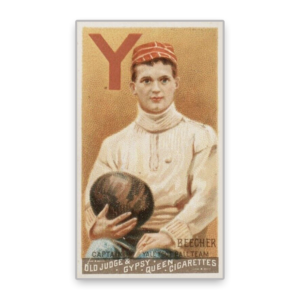
Like most cards of the era, college sports cards originated as tobacco inserts in the late 1800s. These sets primarily featured Ivy League football players. The first college football card appeared in the 1888 Old Judge Gypsy Queen set of 50 cards. It depicts Yale University quarterback Harry (Henry) Beecher (below), who was the only football player featured in that set. Beecher served as captain of Yale’s undefeated national championship team in 1887.
The first complete set dedicated to college football players was printed by the Mayo Cut Plug Tobacco Company in 1894. College football cards pre-date professional football cards by 40+ years. The 1933 Goudey Sport Kings and 1935 National Chicle sets are generally regarded as the first to include professional football players.
College cards remained scarce until the 1950s. The 1950 Topps Felt Backs was Topps’ first dedicated football card set. It featured 100 cards, measuring 7/8″ x 1-7/16″, of college players. The cards were distributed with gum packs. The fronts displayed black-and-white photos against bold colored backgrounds. The backs had a felt-like texture and displayed college pennants. Notable rookie cards include legendary Penn State coach Joe Paterno, as a quarterback at Brown.
The 1951 Topps Magic football set consists of 75 cards featuring top college players. Each card included a unique scratch-off feature on the back that revealed the player’s school mascot and trivia. The fronts display colorized action shots with the player’s name, position, and team in a black box. The backs include vital statistics, biographical information, and the scratch-off panel. Unscratched examples are rare and valuable today. The key card in the set is #10 Vic Janowicz, Heisman Trophy winner.
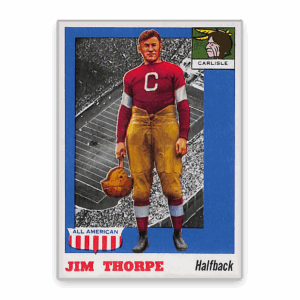
The landmark 1955 Topps All-American football set is described by many vintage collectors as one of the most attractive football card sets ever produced. Key cards from the set include #1 Four Horsemen (Notre Dame’s legendary 1924 backfield), #12 Otto Graham (quarterback, Northwestern), #27 Red Grange (halfback, Illinois), #37 Jim Thorpe (multi-sport star, Carlisle), and #38 Don Hutson (end/wide receiver, Alabama). Topps revisited this classic card concept and design in 2011 with a retro-style release. This modern set featured a blend of retired legends and then-current NFL players and rookies, all pictured in their college uniforms.
As strict amateurism rules took hold in college sports, athletes could not be paid to appear on trading cards. The limited college sets issued between the 1960s and 1990s were mainly used as school and program promotional items and fundraisers.
In 1981, the Collegiate Licensing Company (CLC) was formed to help formalize licensing in college sports. Bill Battle started the company after signing Alabama coach Paul “Bear” Bryant to a licensing deal, and Alabama became CLC’s first client. From there CLC grew into the largest collegiate trademark licensing agency in the country, eventually representing hundreds of schools, conferences, and the NCAA itself. Today CLC still handles licensing for over 200 schools, and it’s the reason card makers need a deal in place before they can put a college logo on a card.
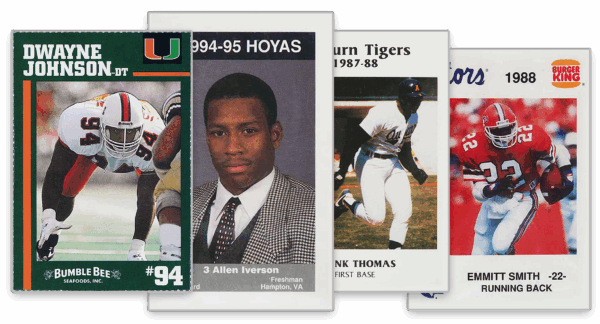
During the 1980s and 1990s, college cards began to regain popularity. Rather than being widely distributed as part of large sets, college programs started issuing small team sets, usually including a regional sponsor. Some of the most popular examples include the 1994 Miami Hurricanes featuring Ray Lewis and Dwayne “The Rock” Johnson, the 1994-95 Georgetown Hoyas featuring Allen Iverson, the 1988 Florida Gators featuring Emmitt Smith, the 1987-88 Auburn Tigers featuring baseball star Frank Thomas, the 1985-86 Minnesota-Duluth Bulldogs featuring hockey star Brett Hull, and the 1990-91 Wildcat News Big Blue showcasing Shaquille O’Neal.
A few years later, Shaquille O’Neal would change the college and professional card industry forever. Leading into the 1992 NBA Draft, O’Neal signed an exclusive deal with Classic that ran until the end of the 1992 calendar year. This meant the only fully licensed cards of Shaq featured him in an LSU uniform. For more details on this monumental agreement, see our Collectibles U chapter on the Ongoing History of Trading Cards.
From the mid-1990s to 2015, the card manufacturer Press Pass focused their efforts on college sports cards. Some of the very first cards and autograph cards of legends like Peyton Manning and Tom Brady are Press Pass cards. Press Pass signed players after they declared for their respective drafts, which did not affect their eligibility or amateur status. This approach let the company build a catalog of early cards for future stars well before being drafted, giving collectors a look at rookies before rookie status ever applied. Press Pass would go on to become one of the go-to names for pre-draft autographs in football and basketball, filling a gap that the major pro licensed manufacturers weren’t yet positioned to cover.
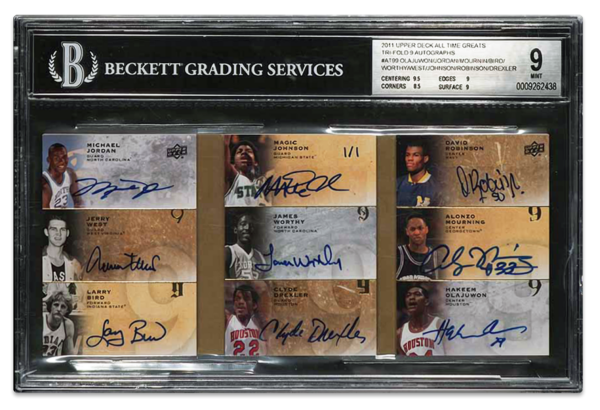
The modern college market with ultra-rare, high-end parallels, autographs, and game-used memorabilia was built up by Upper Deck from 2010 to early 2015 under an exclusive agreement with the CLC. After losing their NBA and NFL licenses, Upper Deck focused their efforts on college cards of established and retired NBA and NFL stars. Having icons like Michael Jordan and Joe Montana signed to contracts made these sets very popular. The strong roster of players allowed them to create spectacular college cards, like a tri-fold nine-player autograph card featuring Jordan, Jerry West, Larry Bird, Magic Johnson, and more (above).
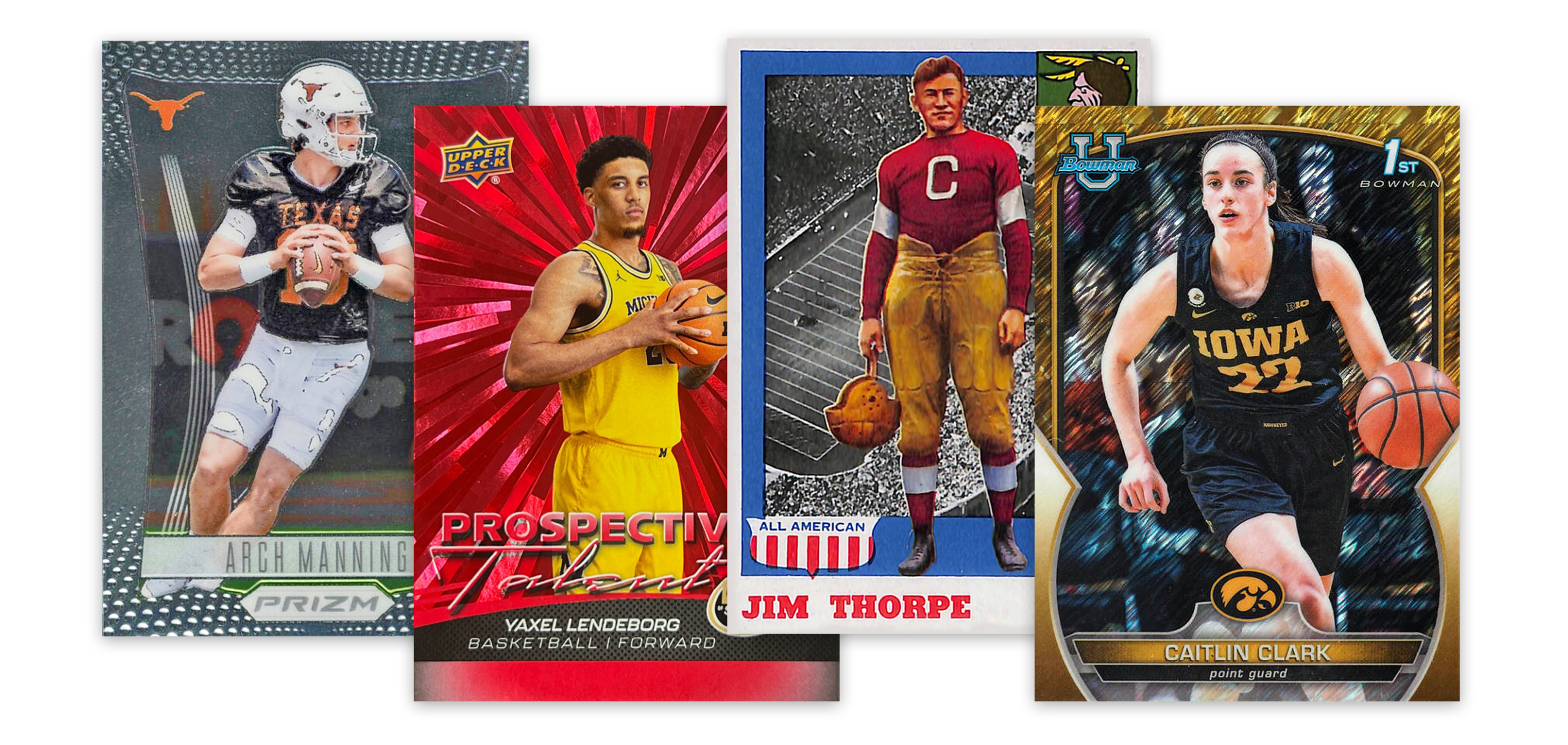
Panini America acquired the CLC exclusive trading card rights from Upper Deck in January 2015, ending Upper Deck’s primary college-licensed production era. Under Panini’s leadership, college cards took another leap forward, continuing having college athletes in top-tier products like Prizm, Immaculate, and National Treasures (below).
Panini quickly built out a deep college lineup once it took over the CLC rights. The company leaned on its existing playbook from pro sports, bringing similar chase-card structure, parallel tiers, and autographs that had made their key products and inserts so popular in football and basketball.

Panini has worked to lock down individual athlete deals early in their college careers, positioning key college players as flagship names well before they turned pro. That approach has continues to define Panini’s strategy, counting on NIL star power and strong brand recognition to drive demand for college-era cards.
Topps entered the licensed college card space in 2022. That June, the company announced partnerships with more than 100 universities, then launched its first Bowman U products that fall, featuring current student-athletes under NIL rights.
Today, Upper Deck continues to hold a presence in the college market, locking down exclusive deals with several key athletes across multiple sports, including a strength in hockey.
ONIT is based in Boise, Idaho. The company was founded in 2021 and started making college cards in 2023. They began with full sets with deep checklists and kept expanding their lineup from there. ONIT was the first company to produce fully licensed college cards for UCLA shortstop Roch Cholowsky, who went #1 overall in the 2026 MLB Draft.
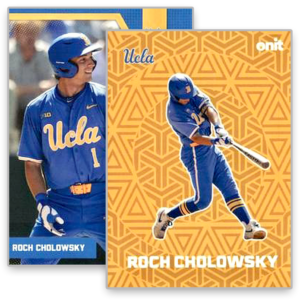
That brings us to today’s landscape, where Topps, Panini, Upper Deck, and ONIT all compete for space, giving college collectors more options than ever.
The Bowman Brand Legacy
Topps returned to the college market with a bang in 2022, continuing the storied legacy of the Bowman brand in its Bowman U college products. Bowman originally became known for launching the cardboard careers of baseball icons like Mickey Mantle and Willie Mays. The tradition has continued in baseball card collecting from 1989 to today, establishing Bowman as the definitive brand for prospect cards. With very few exceptions, every Big Leaguer has a “1st Bowman” card that marks their entry into the hobby. This tradition has made Bowman rookies highly sought after by collectors who value being first to identify future stars.
Now Topps extends that same prospect-focused philosophy into the collegiate arena. Bowman U covers multiple sports including football, basketball, baseball, and hockey. The brand brings the same premium quality and collector appeal to college athletes that it has delivered for professional prospects for decades.
Bowman U Now and Panini Instant
Both Bowman U Now and Panini Instant offer print-on-demand college trading cards, focusing on standout weekly performances typically in football and basketball, but sometimes in other sports as well.

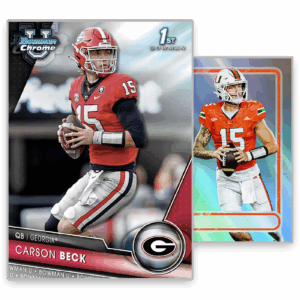
These cards launch shortly after events, available for a limited time, between three and five days, with exact print runs disclosed afterwards for transparency. These on-demand cards capture the moments for collectors as they happen. Like the National Championship Mendoza card (above) which was available within hours of the Hoosiers hoisting the CFP National Championship Trophy. The total print run of the card was 30,616 copies.
On The Horizon
The college sports card market is experiencing significant growth driven by several emerging stars. Caitlin Clark’s remarkable career at Iowa has transformed women’s basketball and women’s sports broadly, elevating interest to unprecedented levels. This visibility has translated directly into surging demand for women’s basketball cards, college and pro. Duke alum Cooper Flagg represents the next generation of elite men’s basketball talent, generating substantial collector interest as a potential future NBA star.
Topps did something very unique this season with the release of 2025-26 Bowman NBA. They included current college basketball prospects such as AJ Dybantsa of BYU, Darryn Peterson of Kansas and Cameron Boozer of Duke into an NBA-licensed product before they were drafted. This product essentially mixed college and NIL licenses into an NBA product.
Beyond basketball, several athletes are reshaping the market across different sports. Fernando Mendoza at Indiana has emerged as a surprise phenomenon, capturing national attention out of nowhere. In hockey, Gavin McKenna at Penn State is establishing himself as a premier talent in a sport that has traditionally received less college card market attention.
In June 2025, Upper Deck re-introduced its World of Sport brand, a multi-sport product featuring top collegiate athletes from 18 schools across baseball, basketball, football, hockey, soccer, gymnastics, softball, tennis, track & field, volleyball, and more. The 2026 Volume II edition released on March 25th, expanding the checklist with athletes from additional schools, including top hockey prospect Cole Hutson from Boston University.
In 2026, the venture firm Seven Seven Six bought ONIT. Seven Seven Six was co-founded by Alexis Ohanian, an avid card collector who co-founded Reddit and is married to tennis legend Serena Williams. Collectors are intrigued by how the company will continue to evolve.
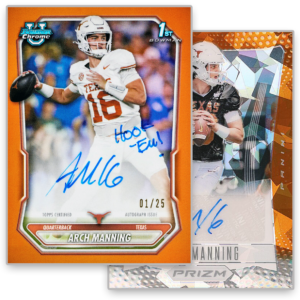
Looking ahead, Texas quarterback Arch Manning stands out as the next potential megastar whose cards could define the hobby’s future. His famous lineage and exceptional talent position him as a centerpiece for collectors anticipating the next wave of valuable college sports cards. From his freshman year, Manning’s cards were exclusive to Panini America. But in early-September 2026, he signed with Topps. His first Topps cards will appear in 2026 Bowman NFL, which also includes several licensed college cards (like 2025-26 Bowman NBA). One of them is the first football card of WWE Superstar Roman Reigns, who played at Georgia Tech.
Conclusion
The college sports card market stands at a pivotal moment. NIL agreements have fundamentally changed how manufacturers can feature active athletes, while the transfer portal has made tracking emerging talent more complex and more exciting. Collectors now have unprecedented access to premium cards of college athletes who may become the next generation of professional stars. The combination of historic programs, breakthrough athletes, and modern licensing structures has created a vibrant marketplace. For both nostalgic collectors and forward-looking investors, college sports cards offer a unique opportunity to capture athletic excellence at its earliest stages. As programs continue to compete for talent and manufacturers expand their offerings, this segment of the hobby will likely continue its strong growth trajectory.
Image sources: eBay, Fanatics Collect, Topps, ONIT
If you liked this story, sign-up for our GRADEx Files newsletter here.

GRADEx Staff
This story is a team effort. Our writers, editors, and hobby experts worked together, researching and reporting to bring you this piece.
Make us a Google preferred source