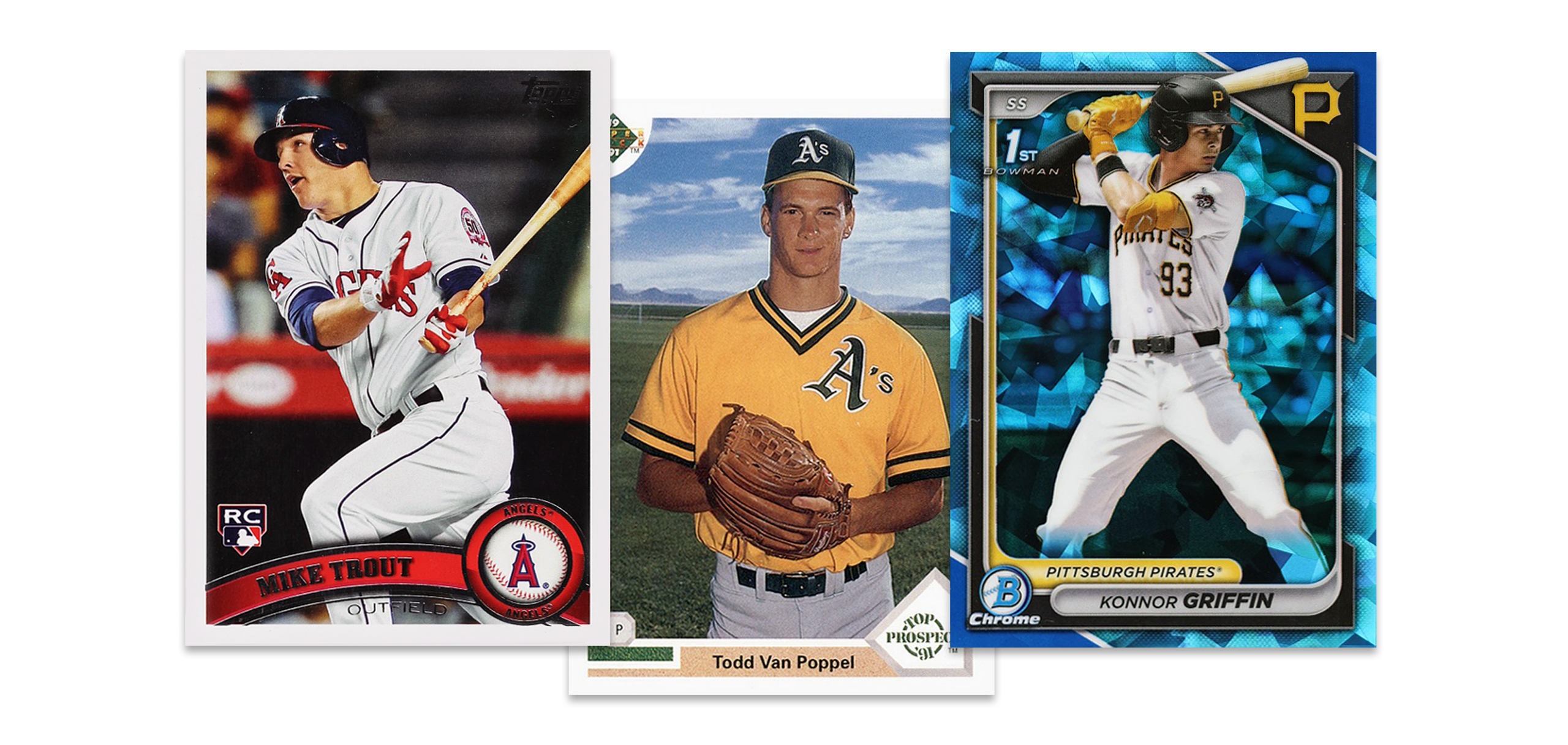
The chase for rookie cards of the game’s superstars has long been central to baseball card collecting. Among collectors, and investors, the most sought-after — and most liquid — pieces have been high-grade copies of elite Major League Baseball players. Names like Mickey Mantle, Hank Aaron, Nolan Ryan, and Ken Griffey Jr. need no introduction. The hobby also has its cautionary tales. Gregg Jefferies, Todd Van Poppel, Rick Ankiel, and Mark Prior were all touted as future greats, and their rookie cards commanded serious money early in their careers before the players failed to meet expectations.
Collectors have long speculated on identifying the next MLB superstar. The Bowman brand was reintroduced in 1989, with Topps including each team’s top minor league prospects in those releases. In 1992, Topps repositioned Bowman as a premium brand, featuring white-stock, high-gloss cards with limited availability. That set contains key rookie cards for Hall of Famers Mariano Rivera, Pedro Martinez, and Mike Piazza — Gem Mint graded copies of which continue to command strong prices. Since ’92, prospecting has become a growing annual tradition among baseball card collectors.
2025: A Banner Year for Young Stars
2025 was a standout year for young baseball talent. Pete Crow-Armstrong of the Chicago Cubs burst onto the scene and established himself as a legitimate superstar in center field at historic Wrigley Field. Roman Anthony was called up by the Boston Red Sox, made an immediate impact, and went on to represent Team USA at the 2026 World Baseball Classic. Jacob Misiorowski announced his presence with authority for the Milwaukee Brewers by throwing triple-digit fastballs and earning a National League All-Star selection after just five MLB starts. Nick Kurtz of the Athletics hit four home runs in a single Friday night game in July, sending his card sales sky-high for the remainder of the season. The Blue Jays’ pitcher Trey Yesavage rose through four levels of the minor leagues and pitched effectively in the World Series.
Anthony, Misiorowski and Yesavage will have their official MLB logo rookie cards in 2026 Topps baseball products, as all three made their MLB debuts after the June cutoff date that Topps uses to determine which players receive MLB rookie cards within that season’s release.
2026 Top Prospects
Five prospects have attracted considerable attention this spring: Konnor Griffin (Pirates), Kevin McGonigle (Tigers), JJ Wetherholt (Cardinals), Jesus Made (Brewers), and Leo De Vries (Athletics). Here is a quick scouting report on each.
Konnor Griffin: Baseball’s consensus No. 1 prospect, the 19-year-old Pirates shortstop posted a .333 average with 21 home runs and 65 stolen bases across three minor league levels in 2025 — earning Minor League Player of the Year honors — and projects as a rare five-tool talent with a MLB debut expected sometime in early April of 2026.
Kevin McGonigle: The Tigers’ 21-year-old infielder combines elite plate discipline and a smooth left-handed swing with a career minor league slash of .308/.410/.512 — posting nearly 39 more walks than strikeouts in 183 games — and made his MLB debut on Opening Day with a four-hit performance.
JJ Wetherholt: The Cardinals’ 23-year-old infielder, taken 7th overall out of West Virginia in 2024, brings double-plus contact skills, plus speed, and a disciplined left-handed approach — posting a .306 average with 17 home runs, 23 stolen bases, a 14.5% walk rate, and a nearly identical strikeout rate across 408 minor league at-bats in 2025 — and made St. Louis’s Opening Day roster as one of baseball’s top five overall prospects.
Jesus Made: The 18-year-old Brewers switch-hitting shortstop, ranked third overall among all prospects, projects as a potential perennial All-Star with a hit tool graded 70, plus speed, and a plus arm — drawing comparisons to Jackson Chourio as the organization’s next Dominican-born franchise cornerstone.
Leo De Vries: The 19-year-old Athletics shortstop, ranked fourth overall, is a Francisco Lindor comp who draws universal praise for his switch-hitting ability, above-average power, athleticism, and feel for the game — putting an exclamation point on his spring with a .426/.460/.723 slash line in Cactus League play.
Understanding the Prospect Market
Baseball America and MLB both publish annual rankings of the sport’s top prospects. The players ranked at the top typically attract significant collector interest and investment over time. Projected power hitters have historically added a premium to card values during their minor league years. Pitching prospects, on the other hand, represent one of the most volatile segments of the hobby. Arm injuries are common among young pitchers, and card values can collapse quickly once a prospect undergoes surgery and faces recovery time.
The prospects featured in these rankings come from a few different pipelines. Most are selected through the annual MLB Draft, which includes both college and elite high school players. Others are signed during the international signing period. This includes older players from Japan’s professional league as well as young prospects — often 16 or 17 years old — from Latin American countries. Notable players who came through the international signing process include Ichiro Suzuki, Shohei Ohtani, Yoshinobu Yamamoto, Vladimir Guerrero Jr., Juan Soto, and Ronald Acuña Jr. Each had a significant impact on the hobby once their rookie cards were released.
The Risk of Speculation
Not every highly-touted prospect lives up to expectations, and their cards tell the story. The Yankees signed Jasson Dominguez as the highest-paid international prospect in history in 2019. His 2020 1st Bowman cards generated serious prices early in the decade, and his official MLB logo rookie cards arrived in 2024, accompanied by flashes of promise in pinstripes. However, patience has worn thin, and his card values have since plummeted — a clear cautionary tale for the hobby.
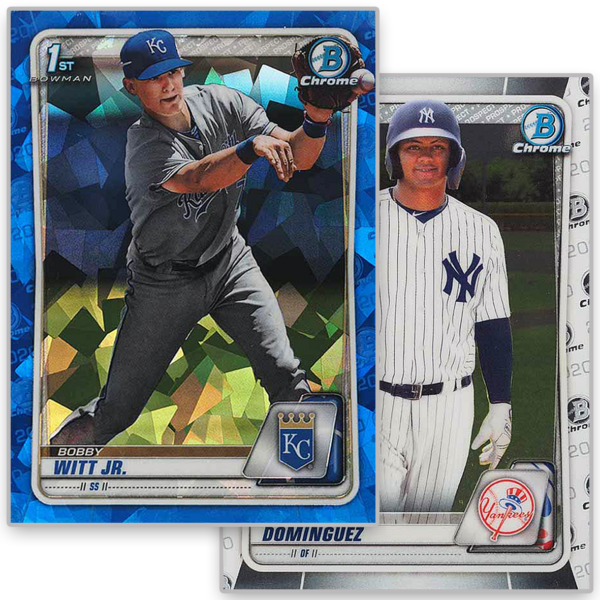
Bobby Witt Jr., drafted by the Kansas City Royals in the 2019 MLB Draft, had cards available in that same 2020 Bowman set. Collectors who chose Witt Jr. over Dominguez have been rewarded for that decision.
The Witt Jr. market offers a useful case study. When he made his MLB debut at the start of the 2022 season, his first Bowman cards were among the hobby’s hottest. Once 2022 Bowman was released in late spring, collector attention shifted toward first Bowman cards of Elly De La Cruz and Jackson Chourio, and Witt Jr.’s values dipped. Those who bought during that dip stand to benefit significantly, provided his Hall-of-Fame-caliber trajectory continues.
Jordan Walker, a 2020 first-round pick of the St. Louis Cardinals, was selected in the same draft class as Spencer Torkelson, Austin Martin, and Pete Crow-Armstrong. Chosen straight out of high school, Walker had the kind of tools that generate real collector excitement. His first Bowman cards sold briskly, and many expected him to follow a path similar to his fellow Missouri-area prospect, Witt Jr. So far, however, Walker’s MLB career has not lived up to that billing — another lesson in the inherent volatility of prospect speculation.
Baseball America Rankings
A look back at Baseball America’s 2006 Top 25 prospects is instructive. The top three were Delmon Young, Justin Upton, and Brandon Wood. Justin Verlander checked in at number eight, Alex Gordon at number thirteen, and Ryan Zimmerman at number fifteen. Four went on to have meaningful careers, with Verlander destined for the Hall of Fame. The rest of the list, however, produced limited impact — a reminder that even the most promising prospect rankings are far from a guarantee.
Let’s take a wider look. Being a Baseball America Top 10 Prospect is an impressive achievement. Becoming a Hall of Famer is something else entirely. Since 1990, how many top 10 prospects actually went on to build Hall of Fame or Hall of Fame-calibre careers?
The list below identifies players who appeared on Baseball America’s Preseason Top 10 Overall Prospect list between 1990 and 2015 and went on to have Hall of Fame or Hall of Fame-calibre (*) careers:
- Chipper Jones
- Jeff Bagwell
- Pedro Martinez
- Manny Ramirez *
- Alex Rodriguez *
- Billy Wagner
- Todd Helton
- Andruw Jones
- Vladimir Guerrero (Sr.)
- Scott Rolen
- Carlos Beltran
- Joe Mauer
- Felix Hernandez *
- Clayton Kershaw *
- Joey Votto *
- Buster Posey *
- Bryce Harper *
- Mike Trout *
What does this look like in percentage terms? Across the 26 lists published during that span, 190 distinct players appeared — many more than once. Of those, only 18 went on to Hall of Fame-worthy careers. That’s 9.47%.
Keep in mind: these were the very best prospects in baseball. Even at that level, fewer than one in ten became all-time greats. The takeaway is straightforward — very few prospects are sure things, and Hall of Fame-calibre players hold their value better than anyone.
Hobby Busts vs Prospect Hype
Collectors who have been around the hobby for a few decades may remember these top-level prospects who burst onto the scene and were hot sellers, but quickly flamed out:
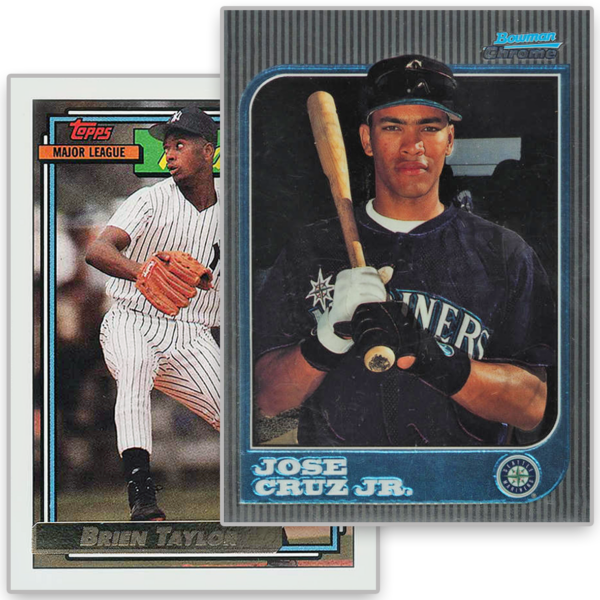
- Brien Taylor (off-field injury)
- Kevin Maas (injuries, couldn’t adjust to pitching)
- Phil Plantier (inconsistent hitter)
- Paul Wilson (chronic injuries)
- Ruben Rivera (off-field issues, poor plate discipline)
- Jose Cruz Jr. (injuries, underperformance vs hype)
- Ben Grieve (lack of power, didn’t meet expectations)
- Jeff Francoeur (decent career, hype vs reality gap)
- Dylan Bundy (injuries, inconsistent command)
- Noah Syndergaard (injuries, inconsistent post peak)
Holding the Bag
Baseball card collectors often treat prospecting as a form of investment, buying cards of up-and-coming players before they reach the major leagues. As a player’s hype builds through strong minor league performances or media attention, demand for their cards can skyrocket — especially for rare parallels and autographs. Limited-edition cards featuring serial numbers, Refractors, or on-card signatures can sell for thousands of dollars if a prospect is seen as a potential breakout star. In many ways, prospecting mirrors stock trading: buy low on potential, sell high as excitement peaks.
Most players’ card values reach their highest point right around their MLB debut, when anticipation and media buzz are at their peak. Once a player settles into the league, performance variability and shifting hype cycles often drive prices down. Savvy collectors aim to sell before the market cools. The risk of being left with a devalued collection once a player’s hype fades is what makes prospecting one of the most thrilling — and precarious — corners of the hobby.
The Bottom Line
Baseball card collecting has always rewarded patience, research, and a willingness to accept risk. The data is clear: even the most decorated prospects fail far more often than they succeed. For every Mike Trout, there are a dozen Brien Taylors. That doesn’t mean prospect cards aren’t worth pursuing — it means they’re worth pursuing carefully. Diversify across names and timelines, buy on dips rather than peaks, and never mistake hype for certainty. The collectors who do their homework and manage their expectations tend to come out ahead. The ones chasing headlines rarely do.

Dennis May
Pricing Editor, Researcher, Writer
Collector since: 1981
Currently: Owner of “The King of Buffalo” eBay Store for 20+ years
Formerly: Upper Deck product development team (MLB, NBA, NFL and NHL products). Dave & Adam’s Cardworld account executive. Ohio Coin Distribution (trading card distributor). “Farewell to the Aud” event team.
Fun Facts: Born and raised in Buffalo, NY. NFL Hall-of-Famer Jim Kelly is a family friend.