Mario Bros. fans are eagerly anticipating The Super Mario Galaxy Movie (April 1, 2026), the sequel to the hugely popular The Super Mario Bros. Movie from Illumination and Nintendo, which grossed $1.36 billion worldwide. On MAR10 Day (Mar. 10), it felt like the right time to review some of the unique collectibles in the Mario galaxy.
Mario’s history in trading cards and paper collectibles traces back to the arcade era, well before the Nintendo Entertainment System reached living rooms across the world. Early Japanese Menko pieces, followed by Topps gum cards, mass-market packs, and fan magazines chart how a coin-operated mascot evolved into a global pop-culture icon.
Nintendo has a long history in the cards and collectibles world. The company’s origins trace back to 1889, when it began handcrafting hanafuda playing cards — a traditional Japanese card game whose name translates to “flower cards.” Nintendo later expanded into Western-style decks, reaching a significant milestone in 1959 with its first licensed Disney character cards. Over time, it broadened its licensed portfolio further, including MLB-licensed playing cards aimed at fans and collectors.
Menko and the Mario Debut
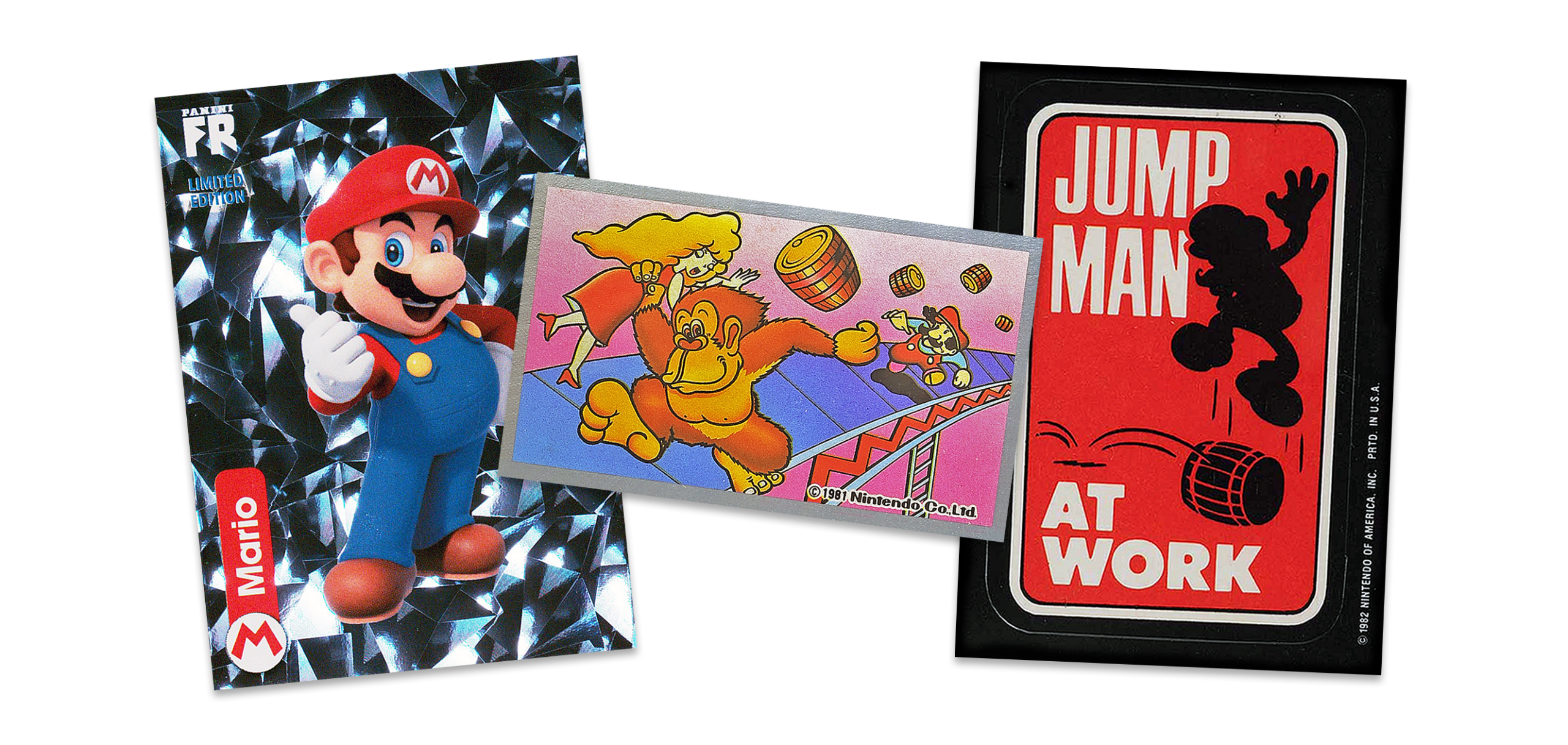
In Japan, Menko cards were a traditional playground game long before video games existed. By the early 1980s, they had become a popular canvas for arcade art and characters. In 1981, as Donkey Kong hit Japanese game centers, manufacturers produced cardboard Menko featuring the cabinet side art (the artwork printed or painted on the outside panels of an arcade game cabinet) — including Donkey Kong, Pauline, and the then-unnamed “Jumpman,” who would soon become Mario.
Savvy collectors identify these pieces as Mario’s true “rookie” or first appearance in cardboard form, predating the Famicom by several years and capturing the character in his arcade roots as a working-class carpenter rather than a plumber. The cards were meant to be tossed, flipped, and scuffed on schoolyard concrete, which makes surviving examples in strong condition remarkably scarce and highly prized among advanced Nintendo collectors.
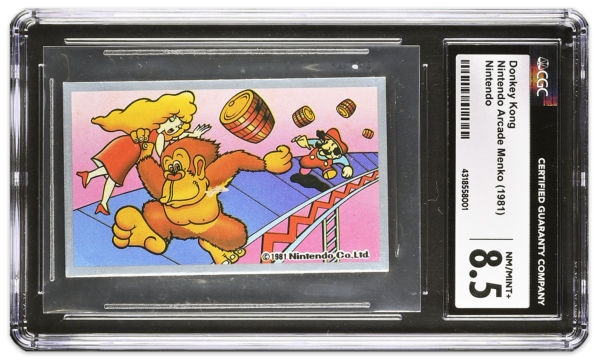
Recent public sales of the 1981 Menko Donkey Kong (above) include:
- CGC 3: $3,000 USD (Jan. 2026)
- CGC 6: $7,000 (Dec. 2025)
The Menko run continued as Nintendo followed Donkey Kong with Donkey Kong Jr. in 1982 and Mario Bros. in 1983. On the Donkey Kong Jr. Menko, Jumpman is officially named Mario for the first time and, unusually, cast as a villain — chaining Donkey Kong while his son attempts a rescue. This twist gives the 1982 Menko a unique place in Mario lore: it marks his first card appearance under the Mario name and his only sustained outing as an antagonist. The 1983 Mario Bros. Menko is also notable for introducing Luigi, widely cited as Luigi’s first appearance on any trading card-style item.
Together, these early Menko issues form a small but historically significant cluster that documents Nintendo’s shift from arcade novelty to character-driven brand, long before Western publishers recognized the commercial potential of video game trading cards.
North American Debut
That recognition came quickly in North America with the 1982 Topps Donkey Kong set. Riding the height of the arcade craze, Topps licensed the property and issued wax packs built around bright cartoon artwork, humor, and stickers rather than screen captures. The cards distilled the game’s simple story — hero vs. ape, girl in peril — into the kind of lighthearted trading-card format already familiar to kids who knew Topps from sports and entertainment sets. The included sticker cards allowed collectors to apply Donkey Kong and Mario imagery to binders and lockers, extending the brand into everyday life.
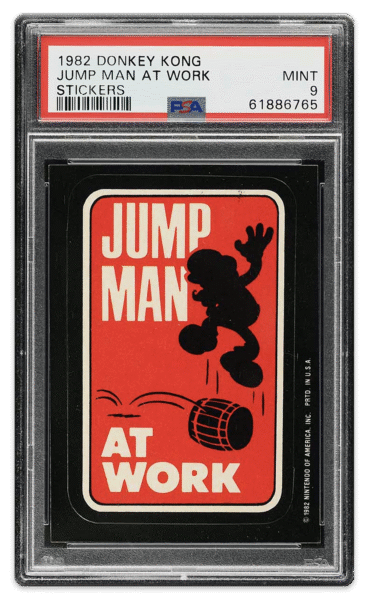
Of course, stickers were made to be peeled and stuck, and scratch-off cards were made to be scratched — and the set’s black borders show every nick and scuff, which means truly high-grade examples are genuinely difficult to find today. For many North American fans, these were some of the first Nintendo characters they encountered outside the arcade, helping establish Mario as a recognizable figure before he ever headlined a console game. The set also demonstrated that video games could sustain a standalone non-sport card product at mass-market scale.
Two cards from the set stand out among Mario collectors: “Jump Man at Work” and “Whack!” Both feature Mario in his early Jump Man persona and are widely regarded as among the most visually appealing cards in the set.
Values of key cards from 1982 Topps Donkey Kong include:
- Jump Man at Work – PSA 9: $700 (pop. 37, one PSA 10)
- Whack! – PSA 10: $550 (pop. 5)
NES Era
By 1989, Nintendo was no longer just an arcade name — it dominated home gaming through the NES, and Topps returned with a more ambitious project: the 1989 Topps Nintendo Game Cards and Stickers. This release combined trading cards with scratch-off mini-games, reflecting both Topps’ tradition of novelty formats and Nintendo’s interactive identity. The set covered six titles — Super Mario Bros., Super Mario Bros. 2, The Legend of Zelda, Zelda II: The Adventure of Link, Double Dragon, and Punch-Out — across 60 scratch-off cards and 33 puzzle-style stickers.
Each scratch-off card presented a simplified, luck-driven take on gameplay, while the stickers featured character art and logos kids could arrange into puzzles or display on their belongings. A second series, distributed in Canada under the O-Pee-Chee brand, added Metroid and fresh artwork. These packs brought Mario, Princess Peach, and other NES icons into the same collecting ecosystem as sports cards, reinforcing Nintendo’s status as a cultural powerhouse.
Values of the key Mario cards from 1989 Topps Nintendo include:
- 1989 Nintendo Stickers #1 Super Mario Bros. 2 Mario Madness, PSA 10: $300 (pop. 10)
- 1989 Nintendo Stickers #9 Super Mario Bros., PSA 10: $125 (pop. 99)
More Mario Cards
As Mario’s popularity grew worldwide, collectors gained access to an expanding range of new material — including phone cards, album stickers, food issues, lenticular cards, card games, and various promotional releases.
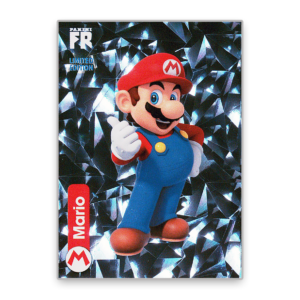
But the 2022 Panini Super Mario Trading Card Collection, released in Europe, stands as the defining modern release in the hobby. The set draws on animation artwork from The Super Mario Bros. Movie, giving it a distinct visual identity. It includes 252 base cards, rounded out by foils, parallels, and inserts that cover Mario’s rich history and iconic characters. Among the standout inclusions is the limited-edition Fragmented Reality (FR) foil insert, which has become one of the most sought-after chase cards in the set.
Nintendo Power Magazine
Running alongside these card releases, Nintendo Power magazine added another dimension to Mario’s collectible history. First published in 1988, issue #1 is widely treated by collectors as a cornerstone paper collectible for the brand. Centered on games like Super Mario Bros. 2, the debut issue blended strategy guides, maps, and promotional art into a comprehensive, officially sanctioned view of the NES world. While not a card set, it functions much like a flagship card — widely distributed, heavily used, frequently discarded, and only later recognized as a genuine cultural artifact.
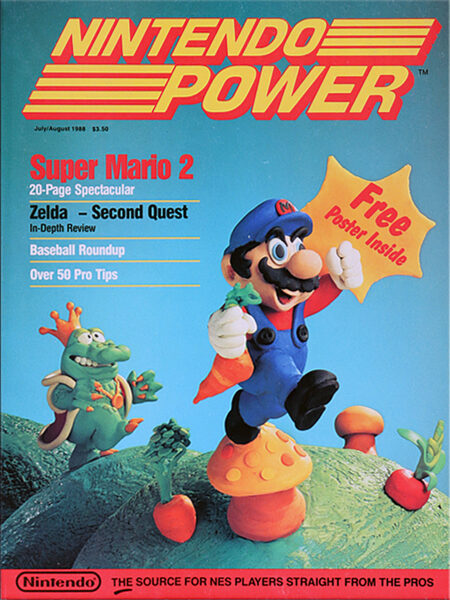
“For those that grew up on Nintendo NES and Mario Bros., the Nintendo Power #1 is peak nostalgia,” says magazine grading expert and hobbyist James Kehoe. “Before the internet, Nintendo Power was a lifeline for maps, tips and tricks. This item has great potential long-term value.”
For Mario collectors, it captures the moment Nintendo evolved from game maker to full ecosystem, with Mario as the enduring mascot across cartridges, cards, magazines, and merchandise.
Recent public sales of graded Nintendo Power #1 (1988) magazines include:
- CGC 4.5: $350 (Feb. 2026)
- PSA 5.5: $488 (Feb. 2026)
- CGC 8.0: $862.50 (Dec. 2025)
- CGC 8.0: $900 (Jan. 2026)
- CGC 9.0: $1,952 (Sep. 2024)
Conclusion
From schoolyard Menko cards tossed on concrete in 1981 to sealed NES cartridges selling for seven figures at auction, Mario’s collectible footprint is unlike anything else in pop culture. No other video game character spans so many formats — arcade ephemera, wax packs, scratch-off cards, magazines, graded games, and modern foil inserts — while remaining just as recognizable to a child today as to the kids who first fed quarters into a Donkey Kong cabinet. That continuity is precisely what drives the market: each piece, however humble, connects back to a character who has never really gone away.
For collectors, Mario isn’t just a nostalgia play — he is an ongoing story told in cardboard, cartridges, and the silver screen, with new chapters still being written.
Images sources: eBay, Fanatics Collect, CGCcards.com, Goldin Auctions

Fabio Del Rio
Founder, Publisher
Collector since: 1983
Currently: Professor and Developer of ‘Business of Sports Collectibles’ college-accredited course and Micro-Credential (Northern College, OntarioLearn). Publisher and Developer of tabletop card games, puzzle games and puzzles. Pitching Coach of Brock University Men’s Baseball team.
Formerly: VP of Product Development and VP of Production at In The Game (former NHL/NHLPA card licensee). Editor and Trends Editor at Trajan Media (Charlton Standard Catalogue of Hockey Cards, Canadian Baseball Cards, Canadian Sports Collector magazine, Non-Sport Report, and more).
Fun Fact: Ate a worm for a jersey, basketball and baseball. Ask for more details when you meet him at a show.