The hottest new name in card collecting today isn’t Paul Skenes, Cooper Flagg, Drake Maye, Macklin Celebrini, Lamine Yamal, or even Miles Morales. It’s Monkey D. Luffy.
Who? Monkey D. Luffy is the main hero of the long-running Japanese series One Piece. He is a cheerful, stubborn pirate who dreams of becoming the Pirate King by finding the legendary treasure known as the “One Piece.” After accidentally eating a magical “Devil Fruit,” Luffy’s body gains rubber-like properties. He can stretch, bend, and absorb punishment in ways that make for spectacular action scenes. Over hundreds of episodes and chapters, he builds the Straw Hat Pirates, a tight-knit crew who sail from island to island. They challenge corrupt governments, rival pirates, and world-shaping enemies. The lengthy journey is filled with loyalty, tension, sacrifice, and humor. It has turned Luffy into a generational pop-culture figure and now one of the most in-demand faces in the trading card game hobby.
Popularity of Luffy TCG Cards
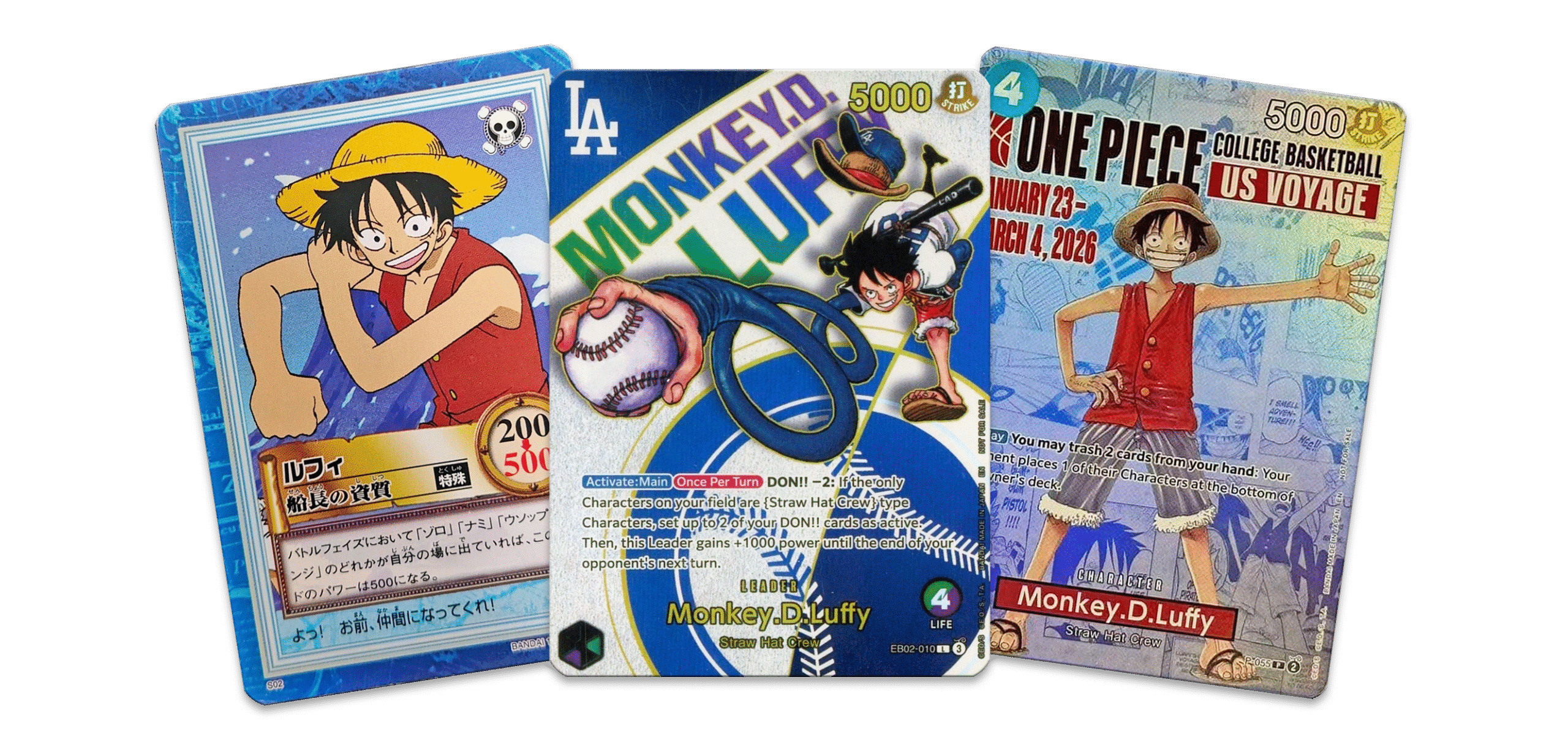
Monkey D. Luffy trading cards have become one of the most active segments of the modern anime card market. The character now anchors both competitive deck building and high-end collecting. This is thanks to the growth of the Bandai One Piece Card Game and Luffy’s global visibility through manga, anime, and major streaming platforms. Collectors and players see Luffy as the central character of the brand. His key cards tend to be the most visible, most discussed, and often the most chased in each release.
Luffy cards are central to the One Piece Card Game because many of them are printed as “leaders.” A leader is the main character card you build your deck around in gameplay. It defines your deck’s color identity, game plan, and the kinds of combos you can play. Strong Luffy leaders naturally see a lot of table time and attention. Players are also drawn to different color combinations, such as dual-color Luffy leaders. These let them combine card pools and strategies that can be powerful in competitive formats.
On the collecting side, Luffy appears on some of the highest-rarity cards in the line. Terms like “SEC” (Secret Rare) mark premium cards that are printed in much lower quantities. They often feature more elaborate art, foiling, or design elements. These become the chase cards cards that collectors most want to pull from packs. They usually command the highest prices on the singles market. Many Luffy chase cards are also sent for grading.
Artwork plays a major role in the demand. The One Piece Card Game showcases Luffy at different points in his story. This ranges from carefree early adventures to his later, more powerful forms. Alternate art versions give multiple visual interpretations of the same character. These “alt arts” are special versions that are harder to pull than the base card. They act as a built-in scarcity layer.
Why Monkey D. Luffy Is So Beloved
Luffy’s card popularity is rooted in the strength of his character arc. He is written as a simple, optimistic hero with an unshakable goal and a deep sense of loyalty to his friends. He repeatedly risks everything to defend his crew and innocent people. Those emotional peaks become key “moments” that fans want to capture in cardboard form.
In Japan, manga and anime series function differently than superhero content does in North America. They are not viewed primarily as children’s entertainment. Instead, many are treated as serialized dramas that appeal to viewers across different age groups. These series often feature complex, ongoing storylines similar to soap operas or prestige television. This approach helps them attract a more diverse and dedicated audience than superhero properties typically command in Western markets.
Over decades, Luffy has also become one of the most recognizable anime protagonists worldwide. The long-running manga and anime have built a multi-generational fanbase. More recent arcs show him at the height of his powers and leadership. The live-action adaptation series and global streaming access (like Netflix) have introduced Luffy to viewers who might not have grown up on anime. This creates new fans who often enter the hobby by seeking out his cards first. For the trading card market, that combination is powerful. It includes an iconic lead character, a strong licensed card game, and worldwide media exposure. This creates an engine where both Luffy as a character and his TCG cards continue to rise in visibility, value, and cultural importance.
One Piece Connection to Sports
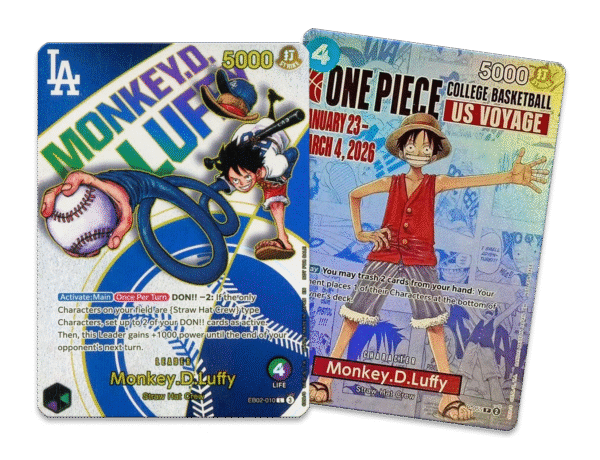
Several One Piece sports promotions have included exclusive trading cards and promo cards.
MLB promotions with cards:
- Los Angeles Dodgers “One Piece Night” (July 2025): Attendees received an exclusive Luffy promo card from the One Piece Card Game. A copy of this card which earned the prestigious BGS Pristine 10 (Black Label) and sold for $15,000 USD in late-January 2026 on eBay. As a comparison, PSA 10 copies of the Dodgers Luffy typically sell in the $2,000 range.
- Seattle Mariners “One Piece Night” (April 2025): The event featured exclusive promo cards as giveaways.
- Boston Red Sox “One Piece Day” (May 2025): Fan packs included promo cards.
NCAA Basketball (January to March 2026): Five teams — Gonzaga, Rutgers, St. John’s, Houston, and Illinois — offered exclusive One Piece promo cards to fans at their games. Sealed Monkey D. Luffy promo card vouchers were distributed to thousands amid sellout crowds at Rutgers University. A burglary of promo inventory from a locked office prompted increased Rutgers police presence for crowd control and reseller issues. Secondary market values for the cards initially ranged from $500 to $800 each, but they have since settled in the $250 to $350 range.
German soccer team Borussia Dortmund vs. Mainz (March 2025): Goodie bags contained exclusive One Piece promo cards.
Conclusion
The rise of Monkey D. Luffy in the trading card market reflects a broader shift in the hobby. Anime and manga properties now stand alongside traditional sports as legitimate collecting categories with their own grading ecosystems, market dynamics, and passionate communities. Luffy’s cards benefit from everything collectors look for: a beloved character with decades of storytelling, multiple rarity tiers and visual treatments, competitive gameplay relevance, and steady media exposure that brings new fans into the fold.
Whether someone is building a tournament deck around a leader card or chasing a high-grade Secret Rare for their personal collection, Luffy has become a flagship name that bridges play and collecting. As the One Piece story continues and the card game expands into new markets, Luffy’s position as one of the most important characters in modern TCG collecting appears secure.
NOTE: Bookmark this page as we will provide updates and more details on this fascinating segment of the hobby.
Image source: eBay

Fabio Del Rio
Founder, Publisher
Collector since: 1983
Currently: Professor and Developer of ‘Business of Sports Collectibles’ college-accredited course and Micro-Credential (Northern College, OntarioLearn). Publisher and Developer of tabletop card games, puzzle games and puzzles. Pitching Coach of Brock University Men’s Baseball team.
Formerly: VP of Product Development and VP of Production at In The Game (former NHL/NHLPA card licensee). Editor and Trends Editor at Trajan Media (Charlton Standard Catalogue of Hockey Cards, Canadian Baseball Cards, Canadian Sports Collector magazine, Non-Sport Report, and more).
Fun Fact: Ate a worm for a jersey, basketball and baseball. Ask for more details when you meet him at a show.