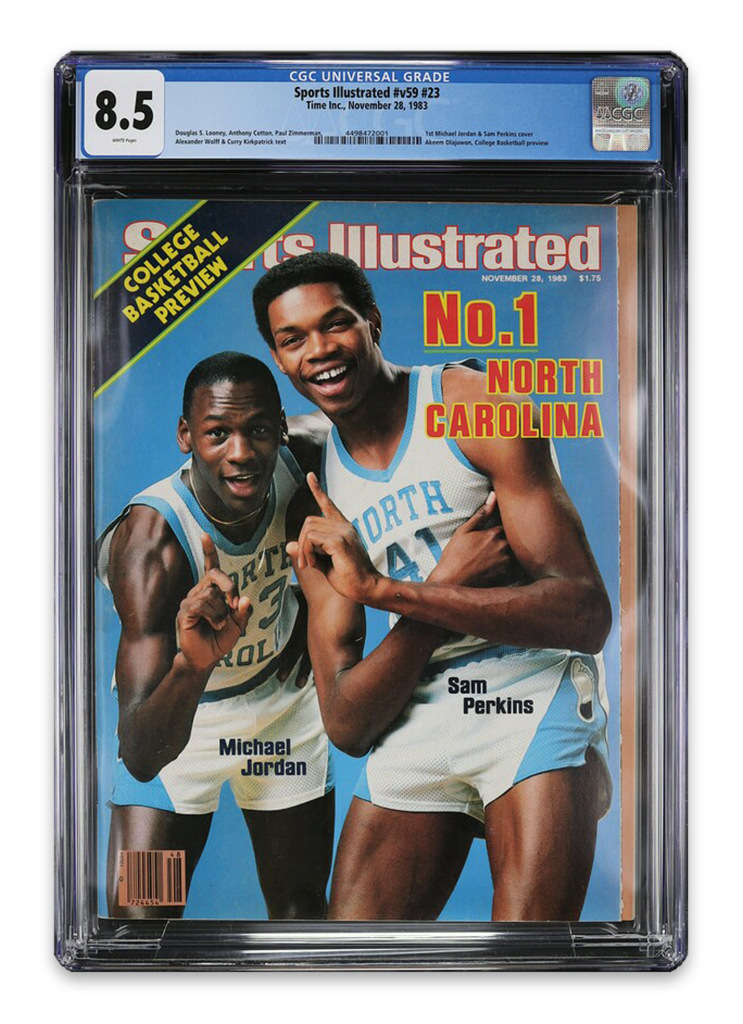
As collectors, we can spend years and sometimes decades building out our collections.
Maybe it starts with a shoebox of your favorite players that you had as a kid but as you mature, new variables come into play. There’s grading, storage, spreadsheets, apps, recent comps, and more money involved.
Before long, what began as a few sports cards morphs into something much bigger, a five-figure, six-figure, or even seven-figure portfolio sitting in safes or even vaults spread across the country.
One more thing before we go further. Everything you’re about to read comes from experts based in the US and Canada, and that matters, because the rules around wills, trusts, and insurance aren’t universal. What works in Massachusetts might not work in Ontario. What applies in Ontario might not apply in Quebec. So take this piece for what it is: a starting point, not a legal document, and treat it as your first step, not your last.
But here’s the uncomfortable question far too few of us are asking:
What happens to our collections when we are gone?
It’s a grim topic, no doubt, but it is also an important one. Without a plan, there is a very real chance that our collections, which have been meticulously curated and assembled, get tragically undervalued, mishandled, or even become a source of conflict inside the family once we’re gone.
And unlike stocks or cash, collectibles come with a whole different set of complicating factors.
Your spouse may not know the difference between a base card and a rare parallel. Your kids may see a stack of cardboard instead of a six-figure asset. A family member trying to help may unknowingly sell a grail card for a fraction of what it is worth.
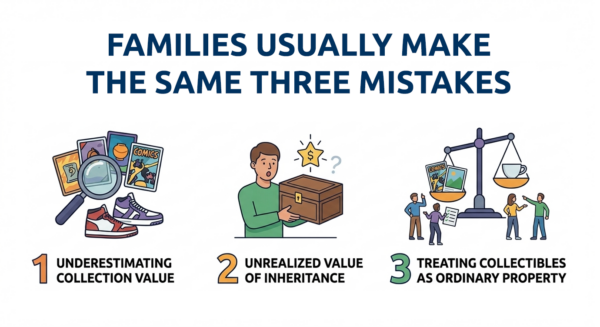
According to Massachusetts trust and estate planner Sean Hagan, families usually make the same three mistakes.
First, they do not understand what the collection is worth, so items get sold below market. Second, someone inherits an item without realizing its value. Third, rare collectibles get treated like ordinary personal property, which can create disputes over who gets what.
In other words, the biggest risk to your collection may not be theft. It may be confusion. That confusion can start long before death, especially when it comes to insurance.
A lot of collectors assume their homeowner’s or renter’s policy fully protects their collection. Former insurance agent, and collector, Massimo Rummo says that assumption is often dangerously wrong.
Most standard policies only cover around $1,000 to $5,000 worth of collectibles unless additional coverage is purchased. Some expanded blanket coverage may raise that to $15,000 to $50,000, but even then, coverage is not automatic.
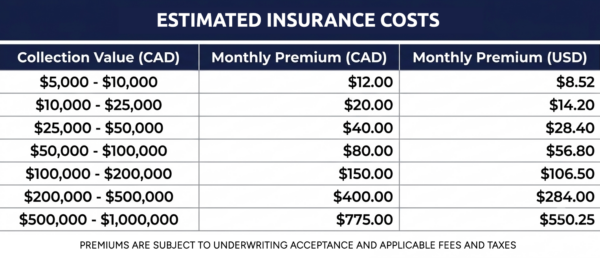
Rummo says the bigger obstacle is often psychological, not financial. Collectors frequently avoid telling their insurer what they own because they assume it will spike their premium. In reality, he says, bumping blanket coverage from $5,000 to $15,000 typically costs around $5 to $10 more a month, a minor price compared to the risk of an uncovered loss.
Keep in mind, many variables affect home insurance costs, including location, age of home, and claims history.
Here is a general breakdown of estimated monthly insurance costs:
According to Rummo, if disaster strikes, “the onus is always on the homeowner to provide proof of what you have,” which often means photos, videos, receipts, appraisals, and sales records. In other words, you need a proper and legitimate paper trail.
Without documentation, filing a claim becomes dramatically harder. Collectors also tend to focus heavily on theft while ignoring another major threat… water.
According to Enzo Ferrari (no relation to the founder of the Ferrari automobile company), owner of Private Collection Insurance / Ferrari Group, water damage is one of the most underestimated risks in the hobby. A burst pipe, sewer backup, flooding event, or roof leak can destroy decades of collecting in minutes.
That risk gets even trickier because many collections no longer live entirely at home.
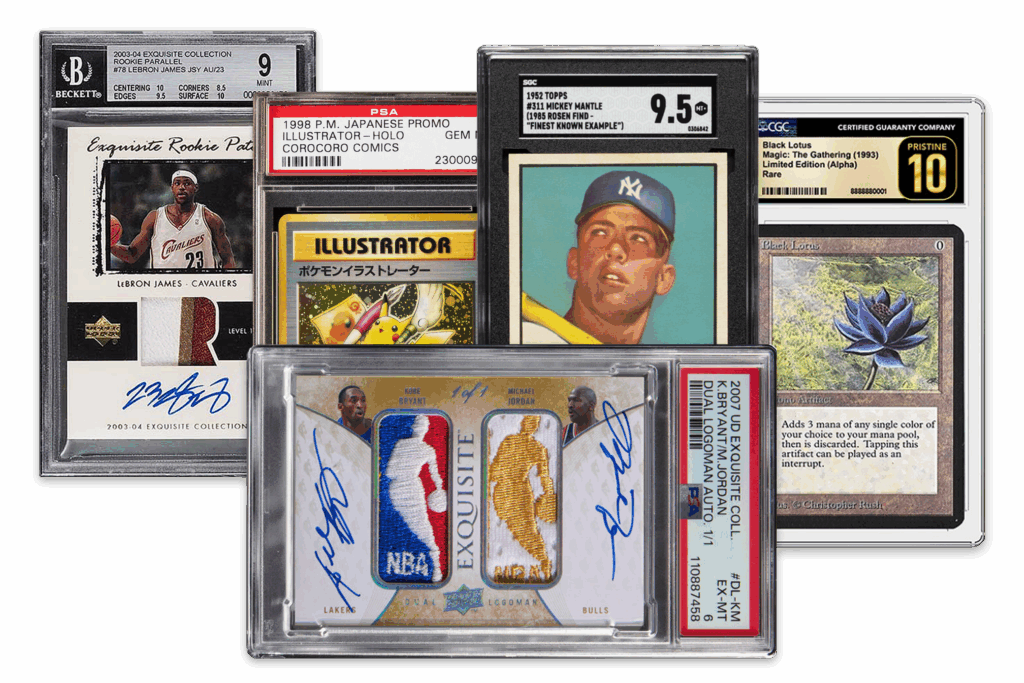
Cards might be spread across safes, safe deposit boxes, grading companies (like PSA, SGC, BGS, TAG or CGC), auction houses, consignment services or private vaults (like COMC, Fanatics Collect or PSA Vault).
Collectors often assume those third parties automatically insure everything, which is a dangerous assumption.

Photo: Fanatics Collect
Ferrari warns that many collectors do not actually know what coverage applies while their collectibles sit in someone else’s possession, or whether those coverage limits come anywhere close to actual market value.
Both Ferrari and Rummo also flag in-transit coverage as a blind spot: cards headed to a card show, sitting in your trunk or on your person at the venue, aren’t automatically protected once they leave your house. Theft at a show is the risk collectors think of, but the coverage gap is usually the bigger problem, since most homeowner’s policies weren’t built to follow a six-figure collection out the front door.
This is critical because collectibles are NOT insured like ordinary property. A laptop can be replaced. A one-of-one rookie-patch autograph can’t.
“With collectibles, you’re not simply insuring the object,” Ferrari explains. “You are protecting authenticity, market value, and often years of passion and research.”
That distinction becomes especially important in volatile markets.
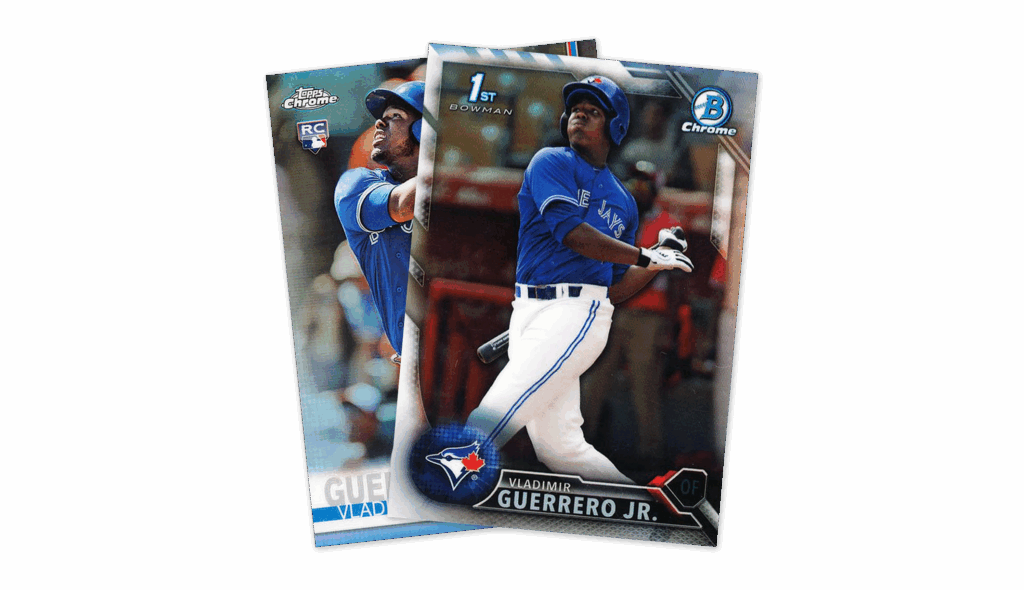
A card bought for $2,500 can become a $10,000 card after a playoff run or fall just as quickly.
These swings aren’t rare exceptions anymore; they’re becoming the norm in the modern hobby.
One hot postseason can send a player’s market skyward, like Jalen Brunson after the historic Knicks NBA Finals. One bad news story can also cut a player’s card market in half. That kind of swing is exciting when you are buying, but it can be a headache when you are trying to protect what you own.

Images: PSAcard.com, SGCgrading.com
Ferrari has watched this play out in his own collection. Formula 1 cards were a niche corner of the hobby as recently as 2020. Today, cards featuring Lewis Hamilton, Max Verstappen, and Charles Leclerc are among the fastest-growing segments in the market, and Ferrari says his own F1 holdings (yes, Enzo Ferrari collects F1) have appreciated dramatically as the sport’s global audience has grown. “What may have been properly insured three years ago could be significantly underinsured today,” he says.
That volatility creates one of the hobby’s most common mistakes, becoming unintentionally underinsured.
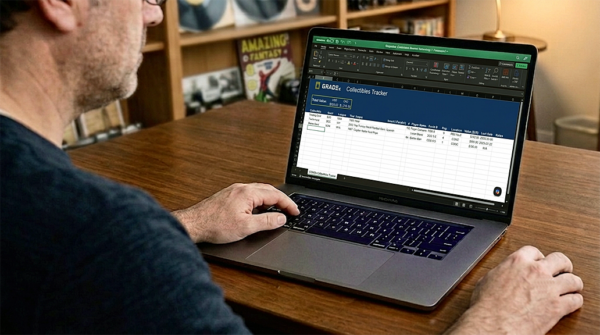
Collectors obsess over comps but forget to update coverage. A spreadsheet helps solve that problem, and it may be the single most valuable thing your family inherits.
Ferrari and Rummo strongly recommend maintaining a detailed inventory with:
- Full item descriptions
- Purchase dates and prices
- Estimated current values (or comps)
- Photos
- Receipts
- Certification numbers
Rummo says one way to accomplish this is to maintain “an up-to-date spreadsheet with details of each item” as well as a “trusted collectible professional” or a friend/relative that knows the space.
Download the sample spreadsheet we created for you here: GRADEx – Collectibles Tracker.
Think of it as a map to your collection. Because when you’re no longer here, your family does not need more mystery; they need instructions, which is where estate planning comes into play.
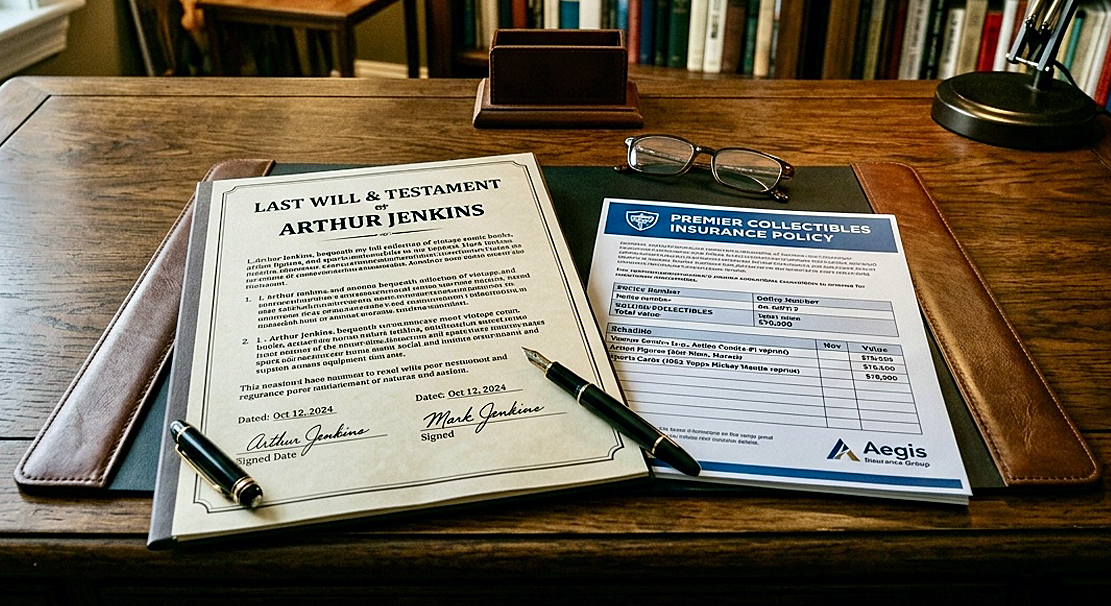
Hagan recommends that serious collectors maintain a basic estate plan, including a will and trust and, when available, a “personal property memorandum.”
That document lets collectors spell out exactly who receives certain items or categories of collectibles.
That could mean something broad like all Boston sports cards going to one child, or something hyper-specific, like a single 1986-87 Fleer Michael Jordan rookie card, going to a particular heir.
Importantly, Hagan says value is not always the only thing that matters. Sentimental significance matters too.
If a collectible means something deeply, financially or emotionally, it deserves documentation.
For collectors leaving assets to heirs who do not care about the hobby, written guidance becomes even more important. A simple letter can prevent expensive mistakes, like who to call, which dealers to trust, or if everything should be auctioned.
Those are decisions your family shouldn’t have to make while grieving.
Here’s a checklist for you to consider:
- Contact your insurance company or broker, close coverage gaps
- Complete the above spreadsheet, including values
- Take photos or videos of your collection
- Keep your items in a safe place, away from sunlight and moisture
- Set up your estate plan, even if it’s just a simple letter with basic instructions
As collectors, we often study population reports, track auction sales, analyze market cycles, and obsess over present value. Yet how many of us have ever spent even one hour planning for the day we’re gone? Probably very few, and that can have devastating consequences.
Because your collection represents so much more than little cardboard photos of players that you liked, stored in a safe or vault.
It represents years of memories, countless hours spent chasing players and cards, and a lifetime of passion that can’t be measured by a price guide. Your collection connected you to moments in time and the players you admired. In a way, it even defines you.
If you died tomorrow, the greatest gift you leave your family may not be the collection itself. It may be the inventory, instructions, and plan that preserve everything you spent a lifetime building so the people you love don’t have to guess what it is worth.
Additional images: Google Gemini
Conor B. McGrath
Researcher, Writer
Collector since: 1992
Currently: Writer at Sports Illustrated Collectibles
Formerly: Researcher, writer, and rare collectibles analyst for Rally, focused on sports cards, comics, rare books, and watches
Fun Facts: Big basketball and Boston sports fan. Won a 7th grade basketball championship alongside 2003 NHL first-round draft pick Brian Boyle.
More: read more of Conor’s work at: https://conorcollects.substack.com/
Make us a Google preferred source