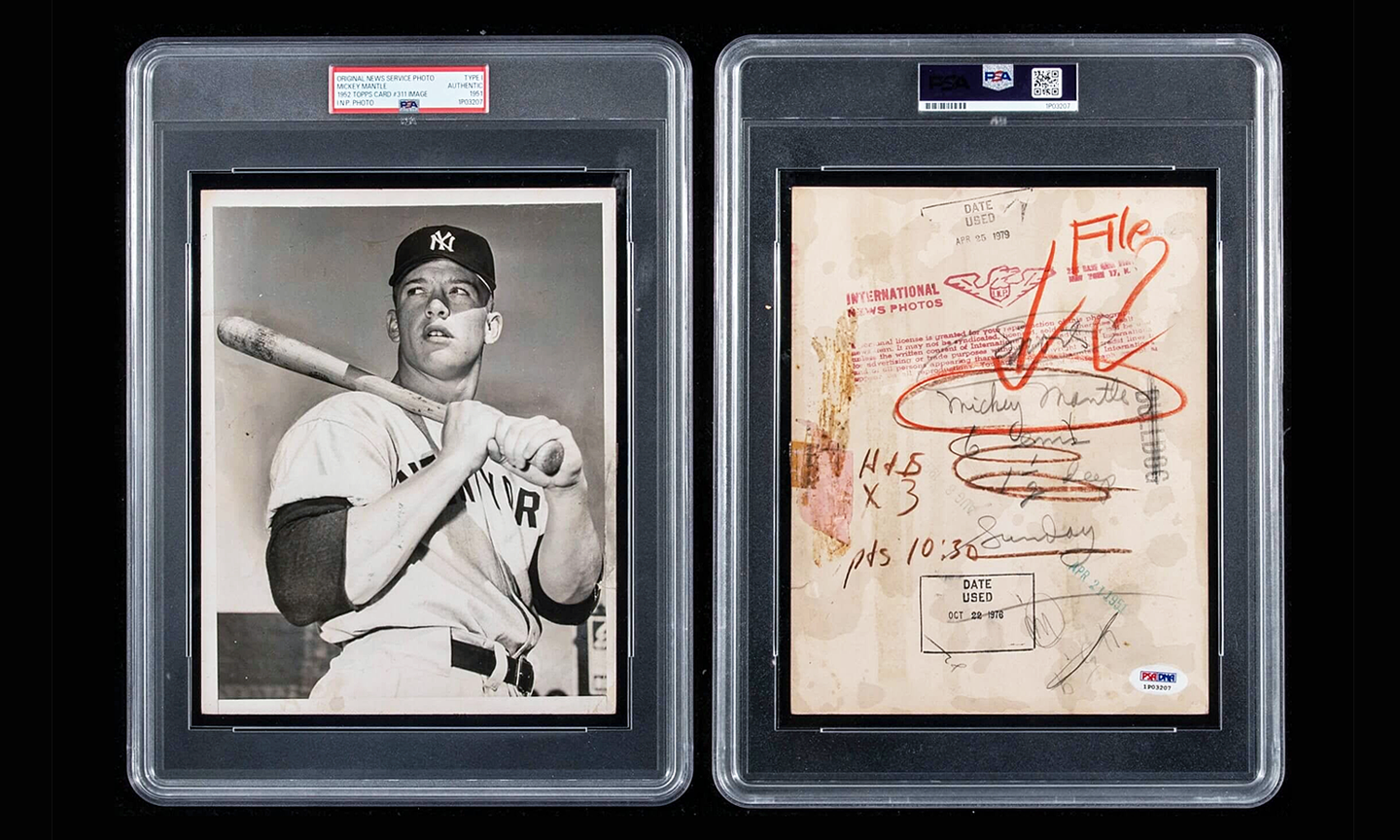
Some of the most valuable pieces in the hobby are not cards. They are the photos the cards were made from. This year, the original photograph Topps used for the 1952 Mickey Mantle card sold privately through Hunt Auctions for $3 million. That has collectors asking what a Type 1 photo is, and what to know before chasing one.
What Is a Type 1 Photo?
A Type 1 photo is a print made straight from the original negative, within about two years of the moment it was shot. PSA sorts photographs into four Types:
- Type 1: Original negative, printed within about two years
- Type 2: Original negative, printed later
- Type 3: Duplicate negative or wire transmission, made within about two years
- Type 4: Duplicate negative or wire transmission, made later
A wire transmission is a photo sent electronically to newspapers. The system comes from the 2005 book “A Portrait of Baseball Photography.” PSA has held the exclusive license since 2007.
Why two years? PSA needed a cutoff between prints made close to the event and prints made later. It has nothing to do with the paper or chemicals. A photograph doesn’t change on its second birthday. Also, the date a photo was taken is not always the date it was printed.
No simple test can tell a print made 23 months after the shot from one made 25 months after. Authenticators weigh all the evidence, which sometimes only narrows the date to a range.
Why Are They Valuable?
Collectors like Type 1 photos because they were made close to the event and straight from the original negative. Many show images tied to important cards, magazines and newspapers.
One common mistake is to treat the type like a condition grade. It describes how and when the print was made, not how it looks, how rare it is or what it’s worth. PSA notes that a Type 3 Mickey Mantle photograph may be worth far more than a Type 1 of a common player. A Type 1 label doesn’t make a common image rare.
A print showing the image used on a card is also not necessarily the exact sheet used to make the card. That stronger claim needs separate evidence.
Wire photos deserve a look too. AP’s Wirephoto service sent images quickly to newspapers. A paper could make a print the moment one arrived, file it and never publish it.
That unused print still counts as Type 3 if it was made through wire transmission within the two-year window. Publication isn’t required. And an unused print does not become Type 1 just because it is old.
Which Are the Most Valuable?
Mantle sits on top. The photo used for the 1952 Topps card set a record for a PSA-authenticated Type 1 ($3 million in a private sale brokered by Hunt Auctions) and PSA has authenticated only three Type 1 copies of the image.
A 1910 Type 1 original of Charles Conlon’s famous “Cobb Sliding” image sold at Goldin in October 2026. Its $945,500 price is the highest public sale of a PSA-graded Type 1 photo. The 8×10 shows Cobb sliding into third base at Hilltop Park on July 23, 1910, and is described as the finest of only two PSA-certified Type 1 examples.
The second-highest public price belongs to another Mantle. The photo behind his 1951 Bowman rookie card sold for $843,750 in April 2024.
Other big sales:
- Michael Jordan, first Nike Air Jordan ad campaign: A signed and inscribed Type 1 original from November 1984, shot by photographer Chuck Kuhn. Only two PSA-certified examples are known. It carries PSA/DNA and JSA autograph authentication and sold at Goldin for $528,937.10.
- Ty Cobb, Cracker Jack source photo: This circa 1910-12 original was used for his 1914-15 Cracker Jack card. It’s a PSA/DNA Type 1 and sold for $516,000 at Heritage in August 2022.
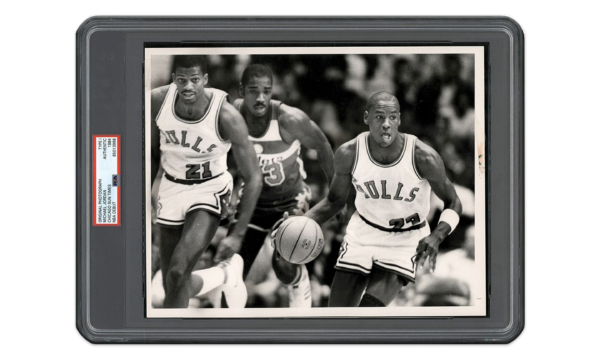
- Michael Jordan, first NBA game: This Type 1 photo from his October 1984 debut sold privately at Goldin for $225,000, topping the previous Jordan photo record of $175,000. Goldin’s Khyber Oser said only three Type 1 examples from the debut had surfaced publicly as of the earlier sale.
- Joe Namath, 1965 Topps rookie photo: Sold for $197,640 in Goldin’s Elite Auction in December 2023, a record for Type 1 football photos. PSA authenticator Henry Yee called it the most important football Type 1 in the hobby.
- Joe Rosenthal, Iwo Jima flag raising: A signed and inscribed Type 1 print sold at Goldin for $103,090, the most expensive wartime image ever sold. It’s one of only three Type 1 Iwo Jima photos PSA has authenticated, and the only signed one.
Who Grades Them?
PSA examines photographs and assigns a type. It offers either a letter of authenticity or encapsulation, which means sealing the photo in a protective holder, like a graded card. Autographs need separate authentication. Beckett announced a photograph authentication and grading service in 2009.
Authenticators look at which negative the print came from, the stamps on the back and any supporting history. A broader exam covers the paper, manufacturer backprints, captions, image structure and signs of alteration. Magnification and ultraviolet light can offer clues, but not an exact printing date.
Stamps can help. A dated receipt stamp from a newsroom may show when a print existed. A later publication stamp may show the photo was reused, not printed again.
The system has limits. Different later prints can share one category, and historically important wire prints sit outside Type 1.
There is also no required Type 1 size. Prints include familiar 8×10s, smaller snapshots and cropped newsroom examples. Colour prints, transparencies and hand-coloured photographs are described differently.
Final Thoughts
Know the image before buying. Before you commit, ask for:
- Front and back scans
- Measurements and condition details
- Evidence supporting the print date
There is still room to grow. Oser has called non-sport Type 1 photos the next frontier, and Yee has said true originals remain undervalued compared to other parts of the hobby. Focus on photos tied to key cards and moments, and the market will tell you the rest.
Images: Hunt Auctions, PSAcard.com

GRADEx Staff
This story is a team effort. Our writers, editors, and hobby experts worked together, researching and reporting to bring you this piece.
Make us a Google preferred source