
The early 1990s were a wild time for trading cards. Companies were experimenting with new designs and printing techniques, and a lot of that experimentation actually paid off. Sure, this era gets a reputation for overproduction, but there was real creativity happening behind the scenes too.
Upper Deck was the first to use small holographic labels on the back of their cards, starting with their 1989 baseball set. The idea was put in place to stop counterfeiters. But holograms and trading cards turned out to be a perfect match, and the pairing stuck around for good. By the mid-90s, holograms weren’t just a security feature anymore. They’d become the whole selling point of certain sets, like Upper Deck’s 1996 SPx Baseball.
A lot of that early hologram work traces back to one guy: Kevin Baumber, Technical Director at a firm called Light Fantastic. He took original photos and artwork and turned them into master holograms and nickel printing plates, work that ended up in Impel’s 1990 Marvel Universe series and Pro Set’s 1990 football and hockey inserts. All of it was shot out of his headquarters in the UK. In a lot of ways, his work helped spark the chase card craze that defined the decade. He still occasionally shares images of original production pieces online.
A handful of cards from this era have reached almost legendary status among collectors. Striking imagery paired with hologram technology. These hologram cards share two things. Mint and Gem Mint copies are very tough to find, and the cards look incredible in hand, way better than any flat digital photo can show.
Here’s a look at some of the most sought-after and influential hologram cards from the early 1990s, spanning both sports and entertainment.
1990-91 Pro Set Hockey — The Stanley Cup
Ask someone to name “the” hockey card of the 1990s and you’ll probably hear a few usual suspects: a high-grade 1990-91 O-Pee-Chee Premier Jaromir Jagr or Sergei Fedorov rookie, the 1990-91 Upper Deck French Pavel Bure rookie, maybe the 1996-97 Upper Deck Black Diamond Joe Thornton rookie. But when you actually weigh everything that matters, significance, looks, scarcity, demand, and how easily the card gets beat up, one card stands above all of them: the 1990-91 Pro Set Stanley Cup Hologram. If any card from the ’90s has earned the tired old nickname “The Grail,” it’s this one.
Only 5,000 sequentially numbered copies were made, buried inside the massively overprinted 1990-91 Pro Set Hockey Series One set. Collectors chase it for its unique look and for how hard it is to find in near-mint condition or better. Ask anyone who owns one and they’ll tell you the same thing: photos just don’t do the hologram justice. You have to see it in person.
Only 312 copies of this card have been graded by the four major card graders, with the highest grades being one PSA 8.5, one SGC 8, two BGS 8.5s, and two CGC 6.5s.
Pricing: PSA 5: $800, PSA 6: $1,400, PSA 7: $2,800, PSA 8: $10,000 (estimate)
As luck would have it, a black border, prototype version of the card recently sold at auction.
1990 Pro Set Football — Vince Lombardi Trophy
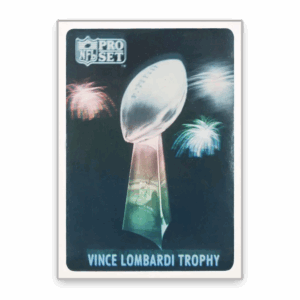
The Pro Set Lombardi Hologram is one of the top chase cards from early-90s football. Only 10,000 numbered copies were made, which is a tiny print run for a set best known for flooding the market. The card shows a holographic Lombardi Trophy set against a fireworks-style background, a design that felt genuinely ahead of its time for football cards back then.
Every card is hand-numbered on the back, “# of 10,000.” Finding one in top condition is brutal. Both the holographic front and the dark back scratch and chip easily, and it’s common to run into centering issues or whitening and peeling on the back.
The standard version is known as the “Collector Edition,” but there’s also a rarer “Owner Edition.” You can tell them apart by a small notation on the back, just left of the hand-numbering. The Owner Editions were reportedly made for special Wilson leather binder sets handed out to NFL team owners, team and league executives, and league figures like Ed Sabol of NFL Films. The numbering on these varies quite a bit too. Some are blank, some are hand-numbered, and some actually have the recipient’s name printed right on the card.
Only 426 copies of the Collector Edition have been graded by the four major card graders, with the highest grades being 39 PSA 9s, four SGC 9s, 11 BGS 9s, and one CGC 8.
Pricing: PSA 7: $275, PSA 8: $650, PSA 9: $1,200 (estimate)
1990 Impel Marvel Universe — Holograms #MH4 Wolverine
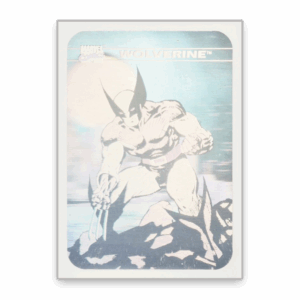
This was the first Marvel set to feature original artwork from some of the greatest comic artists ever, so it’s no surprise it’s still a favorite among Marvel collectors. The five-card hologram insert set remains one of the most chased parts of the whole series. They’re not exactly rare on paper, unofficial estimates put the pull rate at one or two per 36-pack box, but finding one in top condition is another story entirely. That’s largely because the hologram was applied as a sticker over the card’s blank front, which left plenty of room for things to go wrong.
The Wolverine hologram is the standout, brought to life by Jim Lee’s artwork. To this day, it’s one of the hardest cards in the set to find in Gem Mint condition.
2,146 copies of this card have been graded by the four major card graders, with the highest grades being 10 PSA 10s, one SGC 10, five BGS 9.5s, eight CGC 10s (Gem Mint) and one CGC 10 (Pristine).
Pricing: PSA 8: $100, PSA 9: $600, PSA 10: $9,000 (estimate)
1991-92 Upper Deck — Award Winner Holograms #AW1 (Scoring) & #AW4 (MVP) Michael Jordan
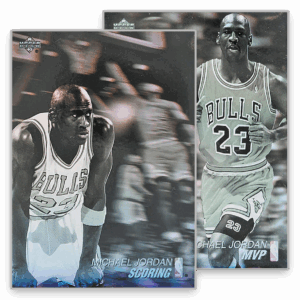
The 1991-92 Upper Deck Award Winner Holograms #AW1 and #AW4 both feature Michael Jordan, marking his NBA scoring title and MVP award. They’re some of his most iconic inserts from that era and his first hologram cards ever. Both are heavily chased by collectors, and both are brutal to find in high grade. The hologram surface scratches at the slightest touch, and centering or edge wear tends to knock most copies down a grade or two. That’s why clean, high-grade examples command such a premium, even with plenty of raw copies still floating around out there. #AW1 tends to get more love from collectors, though demand for both stays strong.
There are also international editions out there, with card backs printed in Italian, Spanish, and French. The fronts look identical to the U.S. version.
11,710 copies of the AW1 card have been graded by the four major card graders, with the highest grades being 149 PSA 10s, four SGC 10s, three BGS 10 (Pristine), 89 BGS 9.5s, and three CGC 10s (Gem Mint).
Pricing: PSA 8: $80, PSA 9: $250, PSA 10: $4,500 (estimate)
12.776 copies of the AW4 card have been graded by the four major card graders, with the highest grades being 441 PSA 10s, one SGC 10 (Pristine), 14 SGC 10s (Gem Mint), 222 BGS 9.5s 13 BGS 10s (Pristine), and 11 CGC 10s (Gem Mint).
Pricing: PSA 8: $75, PSA 9: $225, PSA 10: $4,000 (estimate)
1990 Impel Marvel Universe — Holograms #MH1 Cosmic Spider-Man
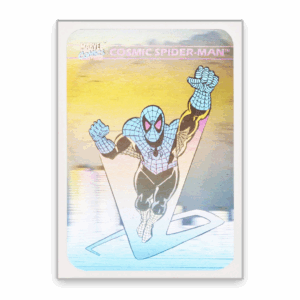
Spider-Man is the most popular and most collected hero in the Marvel Universe, so it’s no shock his first hologram card lands on this list. The Cosmic Spider-Man #MH1 shares a lot in common with the Wolverine card from the same set, and it’s the most frequently graded card in the whole insert set. Between the striking image and the holographic effect, it’s easy to see why collectors keep coming back to it.
Spider-Man actually shows up twice in this set. He shares card #MH5 with Green Goblin, which turns out to be the hardest card in the set to grade Gem Mint. Only four PSA 10s exist for it as of today. The other two cards in the insert set, Silver Surfer and Magneto, are also tough grades and stay popular with collectors.
2,383 copies of the #MH1 card have been graded by the four major card graders, with the highest grades being 12 PSA 10s, one SGC 10, two BGS 9.5s, 14 CGC 10s (Gem Mint) and two CGC 10s (Pristine).
Pricing: PSA 8: $175, PSA 9: $675, PSA 10: $10,000 (estimate)
1993 Marvel Universe Series IV (SkyBox) – 3-D Hologram #H-IV Venom vs. Spider-Man
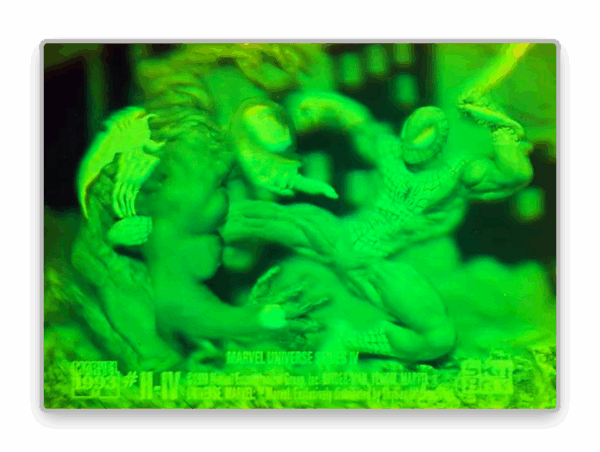
Let’s keep the Spider-Man run going. The 1993 Marvel Universe holographic cards were a real breakthrough in 3-D hologram tech, with a level of depth and visual effect nobody had seen on a card before. This one paired two of Marvel’s most popular characters, Venom and Spider-Man, and it made a big impression on collectors right when the product hit shelves. It came in three color variations: green, gold/orange, and blue. Market data shows green is the easiest to find, gold/orange sits somewhere in the middle, and blue is the rarest of the three.
Approximately 932 copies of this card have been graded by the four major card graders, with the highest grades being five PSA 10, one SGC 10, and five CGC 10 (Gem Mint).
Pricing: PSA 8: $400, PSA 9: $1500 (estimate), PSA 10: $4,000 (estimate)
1992 Impel DC Cosmic — Holograms #DCH8 Superman
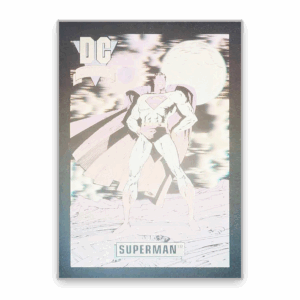
Superman’s first hologram card showed up in the 1992 DC Cosmic set, part of the special “Hall of Fame” hologram insert series illustrated by Walt Simonson. The set had 10 cards total, inserted at roughly 1 per 10 packs, which works out to about 1-in-100 pack odds for pulling the Superman. Like the rest of the insert set, and honestly like most cards on this list, the #DCH8 Superman is tough to find in high grade. Centering issues and surface scratches are the usual culprits.
Only 205 copies of this card have been graded by the four major card graders, with the highest grades being 14 PSA 9s, one SGC 9, two BGS 9s and one CGC 10 (Gem Mint).
Pricing: PSA 8: $75, PSA 9: $350
1991 DC Comics Robin II: The Joker’s Wild Hologram Promos #2 Batman
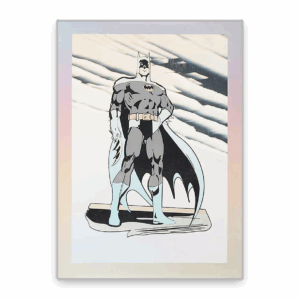
DC Comics released this four-card hologram promo set in 1991, featuring Batman, Robin, the Joker, and the Bat-Signal. Card #2 shows a classic and powerful image of the Caped Crusader. This wasn’t put out by a trading card company. Comic book stores handed these out to promote the Robin II comic series, and collectors have kept them popular ever since thanks to the artwork. It’s also Batman’s first appearance on a hologram card. Well-centered copies are hard to find, and combined with the colorful holographic effect, the card looks striking in hand.
Only 26 copies of this card have been graded by the four major card graders, with the highest grades being one PSA 8, one SGC 8.5, two BGS 9s and three CGC 7.5s.
Pricing: PSA 8: $50
1991 Kayo — Heavyweight Holograms Muhammad Ali
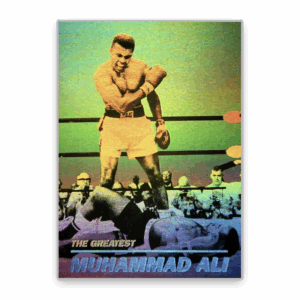
The 1991 Kayo Heavyweight Holograms Muhammad Ali card captures a holographic version of Ali standing over Sonny Liston, one of the most iconic photos in sports history. The card itself is cheap and easy to find raw, but copies graded Mint 9 or higher are a different story. Those are genuinely hard to track down.
Only 141 copies of this card have been graded by the four major card graders, with the highest grades being 12 PSA 10s, one SGC 9, and one CGC 9.
Pricing: PSA 8: $50, PSA 9: $75, PSA 10: $250
1991 Impel Disney — Mickey Mouse Holograms ’92 World Tour & Fantasia
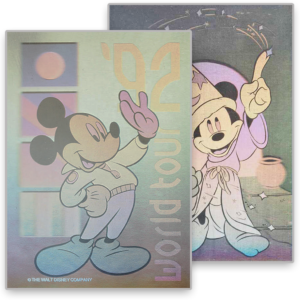
Not every hologram grail features a cape or a sports star. The 1991 Impel Disney Collector Cards set showed the format worked just as well with Mickey Mouse. It arrived at the peak of the card boom, and the print run was large enough that base cards are still cheap today. The two Mickey Mouse holograms, ’92 World Tour and Fantasia, are the real prizes. They were the only inserts Impel made for the release, and they remain the main chase cards in the set. ’92 World Tour is classic early 90s graphic design, while Fantasia draws on the Sorcerer’s Apprentice artwork. Both cards also carry a hologram on the front and the back. That makes a clean copy harder to find, since there are two surfaces to keep free of wear and scratches.
Only 163 copies of the World Tour card have been graded by the four major card graders, with the highest grades being 14 PSA 9s, one SGC 8, two BGS 9s, and two CGC 9s.
Pricing: PSA 8: $85, PSA 9: $325
Only 142 copies of the Fantasia card have been graded by the four major card graders, with the highest grades being one PSA 10, one SGC 9, five BGS 8.5s, and one CGC 8.5.
Pricing: PSA 8: $90, PSA 9: $450 (estimate), PSA 10: $4,500 (estimate)
1993 Topps Star Wars Galaxy — Holograms #1 Darth Vader

This one’s exclusive to the popular Millennium Falcon-shaped factory set, and it’s the first full hologram card in the entire Star Wars universe, featuring an artistic take on Darth Vader. The factory set had a run of 10,000 copies, which is a fairly high number for something like this. Even so, very few of these cards have made it into professional grading, and high grades are even rarer.
Only 15 copies of this card have been graded by the four major card graders, with the highest grades being three PSA 8s, one SGC 8, one BGS 7.5 and one CGC 8.5.
1992 Upper Deck Minor League – Top Prospect Holograms #TP3 Chipper Jones
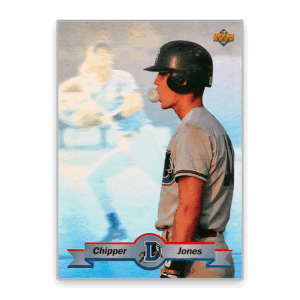
This one’s unique because it’s a hologram tied to a rookie. The 1992 Upper Deck Minor League set was a huge hit when it dropped, packed with a deep prospect checklist and a solid lineup of insert chase cards. The Top Prospect Holograms insert featured nine of minor league baseball’s top prospects, and Hall-of-Famer Chipper Jones is the obvious headliner. Odds of pulling one sat around 1:18 packs, so about two per box.
192 copies of this card have been graded by the four major card graders, with the highest grades being 10 PSA 10s, two SGC 9.5s, four BGS 9.5s and one CGC 9.5.
1991 Upper Deck Denny’s Grand Slam Holograms
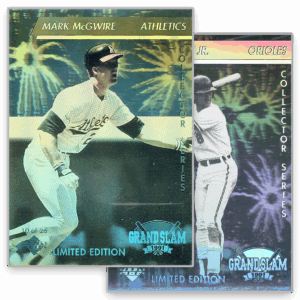
No list of hologram cards would be complete without mentioning one of the biggest mass-market promotions ever. The 1991 Upper Deck Denny’s Grand Slam Hologram set is the most popular MLB hologram series from the early 90s, and it got there through sheer distribution numbers plus a nostalgic tie to the old restaurant promotion. These were the cards Denny’s gave away with Grand Slam breakfast purchases, one star player per MLB team, 26 cards total. That said, because the set leaned into the Grand Slam theme, a few of the era’s biggest stars never made the checklist. No Ken Griffey Jr., no Frank Thomas, no Barry Bonds. Still, the set captured a bigger trend from that era: restaurant tie-ins that helped push trading cards into the mainstream.
These cards were produced in huge numbers, so they don’t carry much value ungraded. That’s likely why only 149 total copies have ever been graded by PSA.
Conclusion
The early 1990s hologram cards mark a genuinely unique moment in collecting history. This era gets tagged as the age of overproduction, but these inserts broke from that pattern with smaller print runs and designs nobody had tried before. Because they’re so easy to damage, high-grade copies have only gotten scarcer and more valuable over time. Sports icons, comic book characters, entertainment legends, it doesn’t matter which category you’re into. Collectors keep chasing these for the same two reasons: they look great, and they were genuinely hard to make. For anyone who lived through the 90s or collects that era today, these holograms still hold a special place in the hobby.

GRADEx Staff
This story is a team effort. Our writers, editors, and hobby experts worked together, researching and reporting to bring you this piece.
Make us a Google preferred source