There’s a detail about Jefferson Burdick that stops you cold the first time you hear it. By the end of his life, his hands were so ravaged by rheumatoid arthritis that handling cards had become genuinely painful. He kept going anyway — mounting, labeling, organizing — until the very last album was done. The day after he finished, he entered the hospital. He never came home.
That kind of dedication deserves more than a footnote. It deserves context.
Before Beckett, There Was Burdick
If you collected cards in the 80s or 90s, Dr. James Beckett probably shaped how you understood the hobby. His price guides brought structure and credibility to sports cards — a trusted standard that took the guesswork out of valuations for collectors and dealers alike.
But long before Beckett, Jefferson Burdick had already laid the groundwork.
A Collector Born on Christmas Day
Jefferson Randolph Burdick was born on December 25, 1900, in Syracuse, New York. He came of age during the height of the tobacco card era, when cigarette companies packed printed cards into their boxes as a way to drive sales. That early exposure stuck. By the time he was an adult, collecting had become less a hobby than a calling.
By trade, Burdick was an electrician — a working man of modest means. His real work, though, was preserving ephemera: the short-lived printed materials like cards, tickets, and posters that most people simply discarded without a second thought. Over decades, his collection expanded well beyond tobacco cards to include postcards, cigar bands, posters, and printed materials spanning the mid-nineteenth century through the early 1960s.
The American Card Catalog
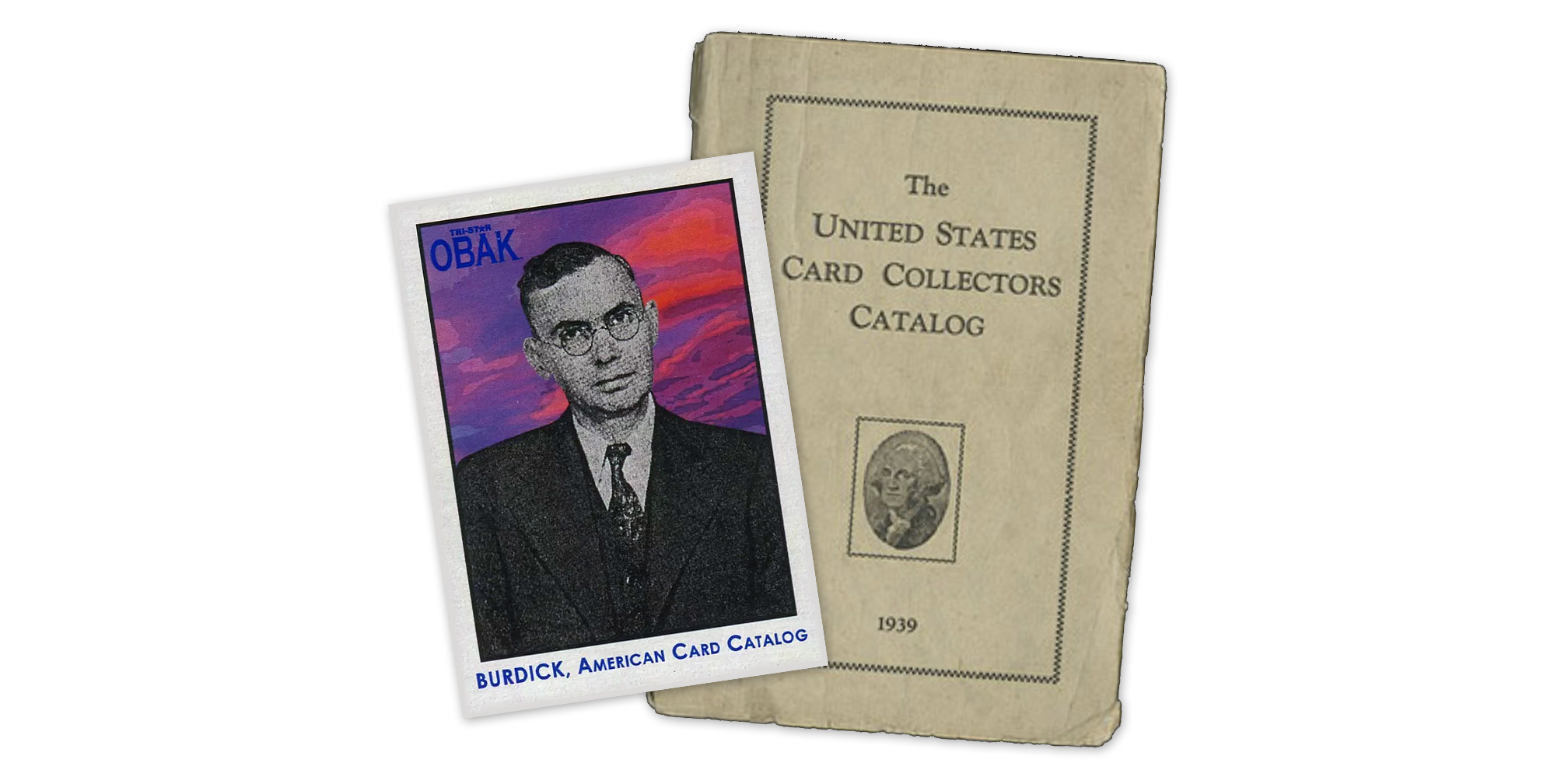
Burdick’s most enduring contribution to the hobby came in 1939, when he published the American Card Catalog — the ACC. It was a comprehensive guide that classified American trading cards using an alphanumeric coding system he developed himself. That system is still in use today. The T206 baseball card set — home to the most coveted card in the hobby, the Honus Wagner — gets its name directly from Burdick’s method. Every time a collector or grader references a set prefix, they’re working within a framework Burdick built.
660 Albums, 306,000 Items
In 1947, Burdick made a decision that set him apart from virtually every collector who came before or after him. Rather than hold onto what he’d built, he donated his entire collection to the Metropolitan Museum of Art in New York City.
Then he spent the next 16 years organizing it.
Working through increasing pain, he mounted everything into 660 albums — thousands upon thousands of cards covering an extraordinary range of subjects. Baseball players sat alongside movie stars, dancers, birds, butterflies, Indigenous chiefs, soldiers, ships, flags, and buildings. By the time of his death in 1963, Burdick had donated more than 306,000 items to the museum. The Jefferson R. Burdick Collection remains one of the most significant assemblies of printed ephemera anywhere in the world.
The Burdick Award
Burdick is widely recognized as the Father of Card Collecting — a title that understates what he actually did. He didn’t just collect. He preserved, classified, and donated, ensuring that future generations would have both a reference system and a permanent record of the hobby’s origins.
In 2020, the Society of American Baseball Research created the Jefferson Burdick Award for Contributions to the Hobby. It’s a fitting tribute. Past recipients include Dr. James Beckett, photographer Doug McWilliams, and artist Dick Perez — people who, like Burdick, gave more to the hobby than they ever took from it.
His collection sits at the Met. His catalog prefixes live in every grading report. And somewhere in that list of 306,000 items is the evidence that a quiet electrician from Syracuse understood something most people miss: that these little pieces of printed paper are worth saving.

Baron Bedesky
Editor-In-Chief, Researcher
Collector since: 1969
Currently: PHPA (Professional Hockey Players’ Association)
Formerly: VP of Communications at In The Game (former NHL/NHLPA card licensee). Editor and Trends Editor at Trajan Media (Charlton Standard Catalogue of Hockey Cards, Canadian Baseball Cards, Canadian Sports Collector magazine, Non-Sport Report, and more).
Make us a Google preferred source