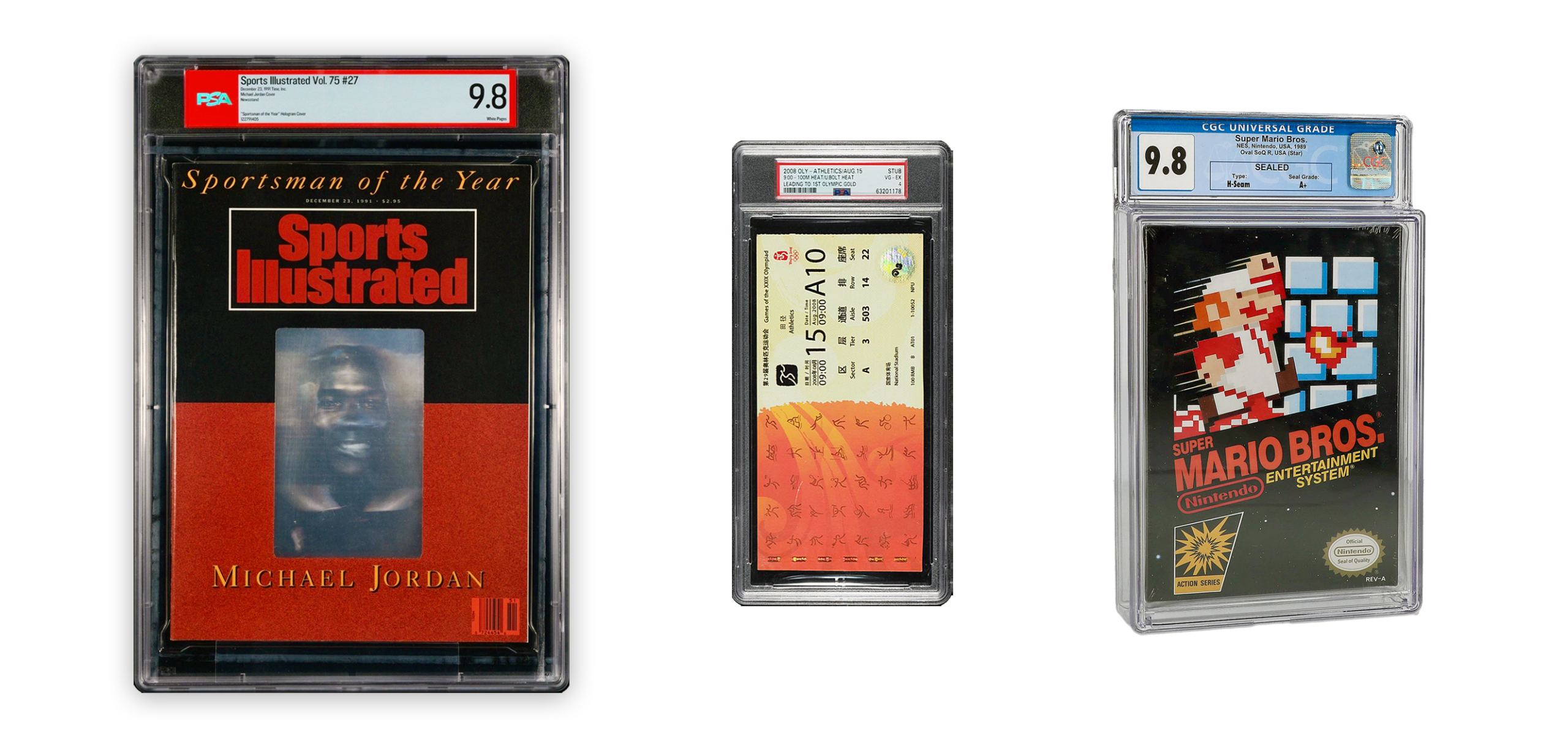
Welcome to Part 2 of our “What Should I Grade” series. This time we’re covering magazines, tickets, and video games.
Grading isn’t just for trading cards anymore. Professionally graded magazines, event tickets, and video games have become a steady part of the market, and collectors in these categories are catching on to the same benefits that card collectors have known about for years. There’s real opportunity in these emerging markets, but there are also real costs to weigh. Basic service levels run between $27 and $150 USD per submission, depending on turnaround time, and those fees add up fast if you’re not careful. Get a second opinion before you send anything in. Condition issues and restorations are easy to miss, and missing one can turn a promising submission into an expensive mistake. Some diligence up front can save you a lot of money later.
Monthly submissions across the hobby’s major grading companies are hitting all-time highs, and the range of collectibles coming through the door keeps growing. So the question every collector eventually has to ask is simple: what’s actually worth grading?
This series looks at grading through the lens of resale value, market potential, and your realistic odds of a top grade. It has nothing to do with how much a piece means to you personally. There are plenty of reasons to grade something that have nothing to do with resale. Wanting a piece authenticated, protected, or ready to display are good ones. If that’s why you’re submitting, some of this advice may not apply to you. If you’re grading purely to build value or turn a profit, though, you have to be choosy. Plenty of collectibles simply won’t earn back what you spend on fees, shipping, and time. Figuring out which pieces are actually worth the submission fee can save you real money. It adds up to a stronger collection down the road.
What Should I Grade?
Magazines
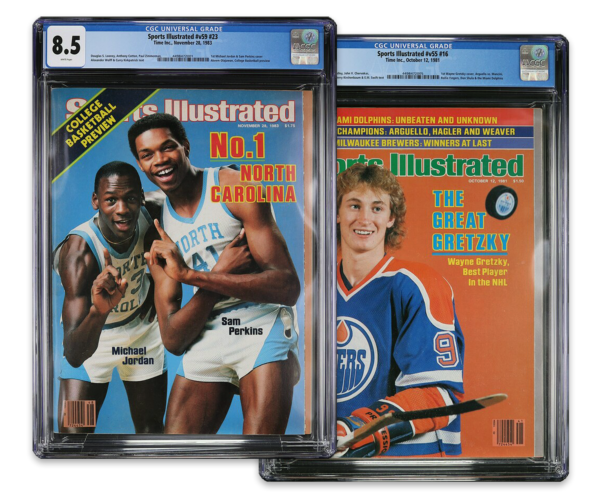
Key grading services: PSA, CGC
Grading fee range: $27.99 to $119.99, depending on turnaround time (Basic to Express)
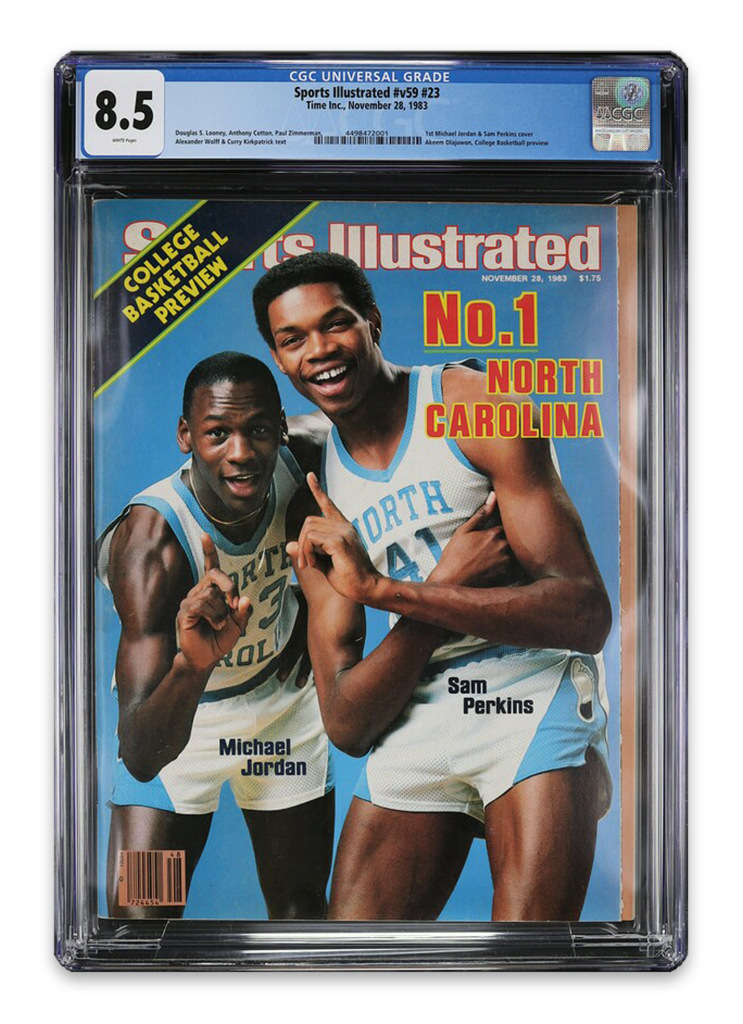
Magazine collector and expert James Kehoe (@CGC_SI) recommends acquiring newsstand issues whenever your budget allows. Vintage newsstand issues in high grade are quite rare compared to subscription issues, carry low population counts, and that scarcity consistently drives strong prices at auction.
Sports Illustrated remains the most desirable title in the hobby, followed by other popular names like Sports Illustrated for Kids, ESPN The Magazine, Beckett Media, SLAM, Baseball Digest, Sport, World Soccer, Golf Digest, and Tennis. Plus TIME and Newsweek with key sports figures on the cover. Game programs are also gaining popularity as grading candidates.

James Kehoe, 2026 National (Fabio Del Rio)
Kehoe also cautions against assuming a recently purchased issue will automatically receive a high grade. Just as not every card in a fresh pack grades a Gem Mint 10, the same logic applies to magazines. A player’s first cover appearance tends to be the most sought-after, much like a rookie card.
Beyond first cover appearances, look for issues tied to milestone moments. Championship seasons, record-breaking performances, and culturally significant events all add collector appeal. A Sports Illustrated from the week after a championship win carries the kind of weight that drives real demand.
Grading for magazines is unforgiving. Spine stress, subscription insert card indentations, and cover creases are common and difficult to avoid. This is part of why newsstand copies hold their edge: without an address label pressed onto the cover, there’s simply one less thing working against the grade. When evaluating a magazine for submission, examine the spine closely. Spine condition can often be the deciding factor between a strong grade and a mid-grade result.
Pressing is another factor worth knowing about before you submit a magazine. It’s a process, accepted by the major grading companies, that applies even pressure and sometimes heat to smooth out common flaws like bends, corner crunches, dents, spine ticks, ripples, and minor stress lines that don’t break color. It can meaningfully improve a magazine’s appearance and grade, but it has limits. Pressing won’t fix tears, paper loss, or creases and stress lines that break color. CGC and PSA offer pressing as a service ahead of certification, so it’s worth asking about before you send a magazine in raw.
Today, collectors are starting to lean toward PSA for sports and CGC for pop culture and sports. For buying and selling high-end graded magazines, Kehoe points to Goldin Auctions as a reliable source. Goldin has fully embraced the graded magazine market and offers a strong selection in many of its auctions, but he has also noticed that all the major auction houses now carry some kind of magazine offerings. Graded magazines had a much more prominent presence at the 2026 National Sports Collectors Convention, a strong sign of growth in the category.
Not all magazines are suitable for grading. PSA sets its maximum magazine size limits at 11.65″ tall x 8.65″ wide x 0.3″ thick, while CGC’s sizing limits are 11.5″ tall x 8.875″ wide x 0.3125″ thick.
For more details on collecting and grading magazines, check out our feature story.
Tickets
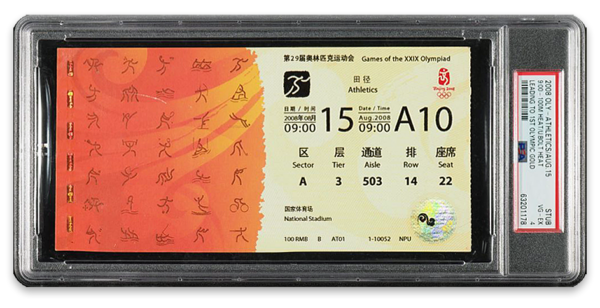
Key grading services: PSA, BGS
Grading fee range: $30 to $149, depending on turnaround time (Basic to Express)
Stubs or full tickets from prominent events or prominent player debuts are worth considering for grading.
Full tickets are almost always preferable to stubs. A full unused ticket sometimes confirms the holder kept the physical artifact rather than attending, and that distinction matters to serious buyers. Full tickets from sellout events, championship games, and historically significant match-ups command the strongest premiums.
Focus on events with cultural permanence. Championship finals, record-setting performances, debut games of generational players, and farewell events for iconic athletes all carry the kind of story that drives prices well beyond what the paper itself is worth.
Condition is straightforward but easy to overlook. Fold lines, water damage, and ink fading are the most common grade killers. Store raw tickets flat and in protective sleeves before submission. Tickets stored in wallets or folded in programs for decades are unlikely to grade well regardless of the event. However, some tickets are so rare and desirable that authentication matters more than the condition. PSA is the dominant grader in the ticket market. Population counts for high-grade tickets from major events remain low, which keeps the ceiling high for top examples.
Want to go deeper on ticket grading? PSA’s Principal Ticket Authenticator Matt Fuller breaks it down in this PSA podcast episode.
Video Games
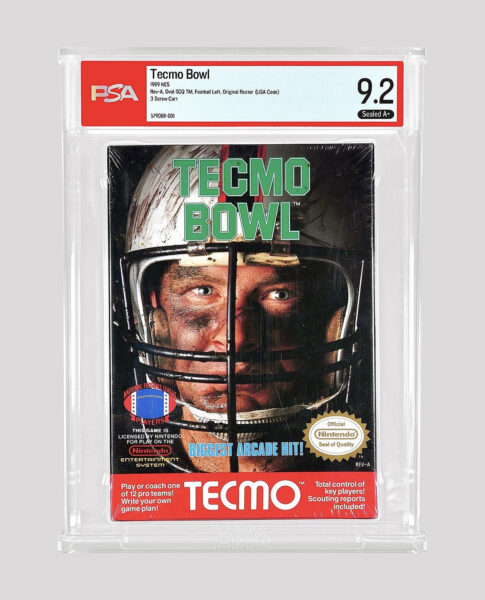
Key grading services: PSA (formerly WATA), CGC and VGA (Video Game Authority)
Grading fee range: $45 to $150, depending on turnaround time (Basic to Express)
Sealed copies of popular or rare titles remain a strong category for grading. The sealed video game market is built almost entirely on condition and rarity. A factory-sealed copy of a sought-after title in high grade represents something most collectors will never open, and that scarcity is the core of its value.
Before submitting, research the print run and history of the title. First-print cartridge games, variant box versions, and region-specific releases often carry significant premiums over standard mass-market copies.
PSA, CGC and VGA are the established graders in the video game space. PSA is generally considered the market leader for high-value submissions.
Not every sealed game justifies grading fees. Common less popular titles with large print runs and heavy market supply rarely see meaningful grade premiums. Concentrate on games with cultural significance, documented scarcity, with strong collector communities. Nintendo titles for NES, SNES, and N64 continue to dominate auction results. But also key Xbox, PlayStation, Atari, Sega, and early handheld titles can carry value too, but research comparable sales carefully before submitting.
Sports titles have carved out their own dedicated corner of the video game grading market. Madden remains the most consistently graded and traded franchise, with early sealed editions from PC, NES and Genesis eras commanding the biggest premiums. NBA Jam has reached a similar status among collectors, and classics like Tecmo Bowl, Blades of Steel, and Double Dribble continue to hold steady demand from NES-era collectors. Baseball has its own deep bench of grading candidates, including Bases Loaded, RBI Baseball, Baseball Stars, Ken Griffey Jr.’s Major League Baseball, and the more modern Backyard Baseball. EA’s NHL franchise, especially early 90s editions like NHL ’94, draws strong interest from hockey collectors, alongside boxing standouts like Mike Tyson’s Punch-Out and the skateboarding series Tony Hawks’ Pro Skater. But the crown jewel of sports game collecting is Stadium Events, an obscure 1987 Bandai track and field title for the NES that was pulled from shelves within weeks of release and is now considered the rarest licensed NES game in existence, with sealed copies fetching well into six figures at auction.
Seal integrity is one of the most important factors for graded games. Original factory seals earn higher grades than re-seals. Graders examine seal type, overlaps, and aging patterns to distinguish originals from later repackaging. If you are unsure whether a seal is original, consult an expert before spending money on a submission.
Each of the three major video game graders covers slightly different ground. PSA grades the widest range of formats, from loose cartridges to Complete-in-Box (CIB) and factory-sealed games, across consoles from Nintendo and Atari through Sega and beyond. CGC Video Games grades boxes, cartridges, discs, manuals, and game-specific inserts, but it does not currently grade unaccompanied manuals, big box PC titles, long box Philips CD-i games, or consoles and accessories. VGA, the oldest of the three, grades sealed and CIB games spanning NES-era cartridges through modern disc-based consoles, and unlike CGC it does accept big box PC CD-ROM titles. If you have a specific format in mind, especially PC big box games or anything outside the mainstream console lineup, it’s worth confirming a grader accepts it before you submit.
How Do I Get Better At Grading These Collectibles?
Like we mentioned in Part 1, start with the grading standards themselves. PSA, CGC, BGS, and VGA all publish their criteria, and it’s worth reading through them category by category. A finger dent on a magazine, a fold line on a ticket, and a reseal on a video game box all get judged very differently. From there, pay attention to the weak points specific to each category. For magazines, that’s the spine and any subscription label marks. For tickets, it’s fold lines and whether it’s a stub or a full ticket. For games, it’s the seal itself and whether it’s original. Look at enough graded examples in each category and you’ll start spotting these issues yourself before you ever send anything in.
Conclusion
Magazines, tickets, and video games each come with their own quirks, but the math behind grading them is no different than it is for cards. Check the population counts before you submit. Know what tends to knock down a grade in that specific category, whether that’s a spine crease, a fold line, or a broken seal. Even a high grade won’t help you if the underlying piece was never in demand to begin with. Do the research first, be picky about what you send in, and the market will tell you whether the grade was worth chasing.
See Part 1 of our “What Should I Grade” series on trading cards.
Images: GRADEx archives, PSA, CGC

GRADEx Staff
This story is a team effort. Our writers, editors, and hobby experts worked together, researching and reporting to bring you this piece.
Make us a Google preferred source